98
|
FALL 2011
IMAGING
//
S H O O T E R
at something significant. During those
moments of opportunity I tried to
keep focused, keep it simple and get
something new. On assignment in
those days, “light” might mean three or
four extra bags to carry or ship. These
days I try to travel without excess
baggage, taking only as much as the
average traveler.
I love the new digital cameras and
zoom lenses. The high ISO ranges now
available (which have a greater sensitivity
to light) have really kept me in the game.
I get a great kick out of the fact that as I
get older and slower, cameras get faster
and more forgiving. Shooting at very
high speed and great depth of field opens the door to
shooting new situations and using new approaches. I think
photography has never been so welcoming, but at the
same time the bar has never been so high.
SF//
What is the most important tool you must
have with you when you go on an expedition?
FN//
My most important tool hasn’t changed in 30 years:
a researcher who wants to share new discoveries and
is willing to put me in the right place at the right time.
It’s amazing how long you can wait for great situations
and how easy photography is when those situations are
happening in front of you. The researchers know where
to look for those moments, and, luckily for me, they’ve let
me tag along with them. They also taught me a bit of their
philosophy. You can’t save everything cute, eat everything
that tastes good, and kill everything you’re afraid of and
expect a working ecosystem to come out of it.
SF//
Tell me something about working with whales
that would surprise those thinking about doing it.
FN//
The amount of federal and state permits required
to do so. A commercial photographer’s options in the
U.S. are:
•
Apply for a commercial/educational photography
permit from National Marine Fisheries Service
(NMFS).
•
Abide by the NMFS regional viewing guidelines.
Each NMFS region has recommendations on the
distance you should remain from marine mammals.
•
Accompany a permitted researcher. Photographers
can choose to partner with researchers already
authorized to approach marine mammals, though
filming must not interfere with the research.
Abiding by these processes has allowed me close
access to whales over the years. However, there are
places in the world where whale access is not under
government supervision and the rules and expectations
are different. Local knowledge and good planning will
serve the whale photographer better than luck, although
a dose of luck is always appreciated!
SF//
Can you give us a few specific tips you’ve
learned on lighting whale photographs?
FN//
Sure. Let’s take strobes, for example. I know how
important they are for a coral reef photographer, but
I usually don’t use strobes underwater in the wild. I
worry the bright flash and recycling hum are distracting
to my subject. They also slow me down; getting into
the water quickly and swimming freely are both very
important in these often very short encounters.
I have used flash in captive situations but would be
very sensitive to possible reactions by dolphins. This
has really been successful only in bright situations. Here
the pop of a strobe can help. Using natural light means
always thinking about light, or lack thereof. Shooting
whales at 50 or 60 feet is tough — light and contrast go
away. But the behavior is often not on the surface.
The new digital cameras are much better than film
in these situations, but you have to be very conscious
of what light you have. The new image-processing
software helps augment color better than slide film did,
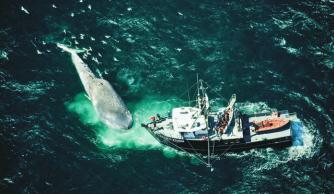
Above:
Researchers
aboard the
R/V Pacific
Storm, under
the leader-
ship of
Bruce Mate,
investigate a
blue whale
killed by a
ship strike
near Santa
Barbara,
Calif., in
2007.
Below, right:
Nicklin took
this photo of
a 1-year-old
killer whale
breaching
with its pod
close by,
near Seward
Alaska, in
2003, while
working with
researchers
Craig Matkin
and Eva
Saulitis.
90-99_Shooter_Fall2011.indd 98
9/30/11