www.alertdiver.com
|
99
but still, many whale images are inherently monochromatic.
Wide lenses and working close to animals are really the key
to crisp, clear images.
SF//
For me, your topside images of whale action are as
compelling as the underwater ones. Can you share some
insights into that discipline?
FN//
Shooting from moving platforms that bounce and
vibrate is sort of a specialty for me. I have few, if any,
whale pictures shot with a tripod. Maybe some on the
ice, where I carried a 600mm f/4 lens. But I got much
more use from a 300mm f/2.8 or 80-200mm f/4 zoom lens.
Usually I use a handheld, but I have used a monopod from
time to time.
With Kodachrome 64 back in the film days, I was
shooting 1/1,000 sec at f/2.8-4 on sunny days. This stops
action only at the apex of a leap, but it’s all we had. With
higher shutter speeds things got much better. With the
Nikon D3 and higher ISO speeds, I’m now shooting at up to
a 1/4,000 sec and f/8-11 on sunny days. I get better depth of
field and can stop the action, and the high ISO performance
of these modern cameras is so good the digital “noise” is
minimal.
Of course, calm water is my friend. It is much easier to
shoot on mirror-flat days. You see more, and the reflections
make much more interesting images. If I had the choice, I
would go home at the first sign of wind, but that is not how
the world works. Some great things happen in the wind,
like leaping whales with spray. But cameras do not like salty
spray, and I’ve killed more than my share. I try to shield the
camera with my body or keep a cooler with me to store gear.
I have always been more careful with gear at the beginning
of an assignment than at the end. Use your oldest gear in the
worst weather, and remember that waiting out bad weather
is always an option.
SF//
Tell me about some of the different types of whales
you’ve photographed and how you consider the shot.
FN//
Most of the time whales can look like big lumps.
Narwhals without the tusk up are very hard to read. Others
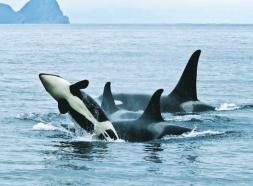
are more enigmatic. Killer whales are very photogenic
because of their big, beautiful dorsal, and they can be
very active on the surface, breaching and waving tails.
Humpbacks are another very active whale, and breaches are
always popular. You can really see the whale.
I try to find the rhythm of jumps or tail lobs (there will
usually be a pattern), but sometimes you just have to guess
where the action will be. Gray whales in the Mexican
lagoons may be the most fun. It feels great when a mom
pushes her youngster to the boat!
SF//
Is it critical to be in or on the water to get a decent
whale shot?
FN//
No, boats are certainly not the only way to shoot
cetaceans. I get up in small planes or choppers anytime I
can. Usually you have to stay above 1,000 feet, sometimes
more, and it is good to measure off distances to see what
lens you might want. For me, usually the 300mm and
70-200mm range works well. I also feel I have not shot
enough from cliffs and beaches with long lenses; I’m leaving
some of those things for my old age.
SF//
Your dad once told me he thought your freediving
skills were as important as your photographer’s eye in
the development of your career. Do you agree?
FN//
I grew up freediving and would be very happy to do
all my diving with only fins, mask, snorkel and a camera. I
freedive because it is less likely to influence cetacean behavior,
and it is fast. I couldn’t have done what I’ve done without
good in-water skills and the savvy to avoid associated hazards.
I love diving in Hawaii, where my gear is a T-shirt, fins,
mask, snorkel and camera. Diving in the Arctic takes a lot
more gear and effort, and I think closed-circuit systems and
remotes will produce great images of whales and dolphins in
the future. Freediving is enough for me.
I don’t push it though. Much of my best work is done
floating on the surface quietly, letting behavior happen
around me. I think I’ll be doing that for a while to come.
Like my dad always told me, “If you get dead, you can’t take
any more good pictures.”
AD
90-99_Shooter_Fall2011.indd 99
9/30/11