British Columbia
Water temperature in British Columbia does not vary much
with the seasons and is typically 45-50°F. Browning Pass,
located near Port Hardy at the northern tip of Vancouver
Island in British Columbia, features some of the finest diving
in the Pacific Northwest. Tidal currents can be quite strong,
and many of the best sites can be dived only at slack tide.
The signature dive is Browning Wall, a steep dropoff on the
western side of the pass that begins at the surface and descends
hundreds of feet. The sheer density of living things is amazing
and includes crimson and plumose anemones, red soft corals,
colorful sponges, candy stripe shrimps, Irish lord sculpins,
grunt sculpins, warbonnets, giant octopuses and several kinds
of nudibranchs. There is so much life on this wall that focusing
attention on one subject at a time is difficult at first.
The size of many of these animals is impressive. Most
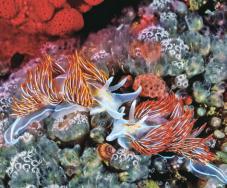
tropical nudibranchs I was familiar with are less than an inch
long, but most of those witnessed in British Columbia are
several inches in length, while the white plumose anemones
boast a height of 3 feet or more. The sunflower sea star is
the world’s largest; this voracious predator reaches 4 feet
in diameter and may have as many as 24 arms. The giant
Pacific octopus is the largest of its kind with an average
weight of 33 pounds and an arm spread of 14 feet, though
larger specimens have been reported. The spectacular lion’s
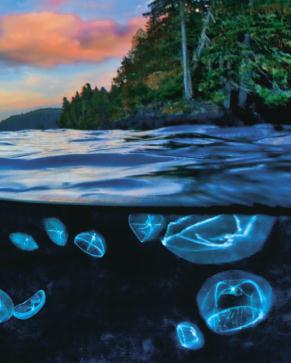
mane jellyfish, a common species in these cold waters, can
reach 6 feet in diameter with tentacles 30 feet long. Male
Steller sea lions can reach a ton or more; they are the largest
of the eared seals and the fourth-largest pinniped. Compared
to the tropics, this is wildlife on steroids.
The variety of life, especially invertebrate life, in the
Pacific Northwest is also extraordinary, and many of the
animals and species are endemic. There is more than
enough to keep an intrepid photographer busy.
New Zealand
My first foray into New Zealand waters was at the Poor
Knights Islands Marine Reserve. We wore thick wetsuits,
gloves and hoods and spent a lot of time shivering, but
the diving was excellent. The marine life was a mixture of
warm- and cold-water species in a rocky, kelp environment.
I photographed moray eels entwined in kelp and many
large nudibranchs I had not seen before. Cold-water species
included the John Dory and large schools of blue maomao.
I returned with my drysuit three years later to spend
a couple of weeks diving the Poor Knights along with a
third week at Milford Sound. The latter is one of the deep
fiords within Fiordland National Park on the southwestern
tip of the South Island. Numerous waterfalls spill into the
sound, depositing an enormous volume of runoff from the
surrounding rainforest and resulting in a permanent 15- to
20-foot freshwater layer on top of the ocean water. The
freshwater is tea-colored from decaying forest vegetation
and absorbs a great deal of light. As a result, deepwater
species, such as huge colonies of black coral, can be found in
relatively shallow water.
www.alertdiver.com
|
101
Above: Moon jellyfish and cross jellies in Browning Pass, British Columbia
Bottom: Opalescent nudibranchs and ascidians, British Columbia
100-103_Photo_Techniques_Fall2011.indd 101
9/29/11