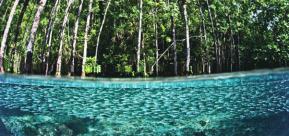
F
luttering green canopies 30 feet above the waterline
shade tranquil worlds, worlds unknown to most
divers. The canopies are the living roofs of dense
mangrove forests that grow along the convoluted
shores of islands and other coastal areas. Environmental
conditions in these semiaquatic habitats are persistently warm,
humid and shallow. Mangrove trees do not merely compose
wet forests, they produce a fundamental ecological unit
bonding the land to the sea. Without them, tropical marine life
would be far less abundant, and diving coral reefs and other
marine habitats would be a very different experience.
Complex Beauty
Organisms that live even part of their lives in the shifting
conditions where mangrove communities evolved have a
difficult existence. Only 50 to 60 species of trees play significant
roles in the world’s mangrove forests, and each day the
plants and animals living within them must deal with hours
of desiccation as the tide recedes and then hours of flooding
during high tide. Soft mud low in oxygen and high in sulfur and
bacteria comprises a sludgelike soil in which most terrestrial
plants would wither. Ravaging wind and waves continually
batter mangroves, and water salinity varies dramatically
according to the amount of local rainfall. These ever-changing
conditions have led to peculiar adaptations that take advantage
of the rich resources that exist where the land and sea converge.
One of these adaptations is viviparity in mangrove trees: Seeds
germinate on the parent tree before dispersing. Trees have also
evolved unique salt-exclusion methods and grow complex,
supportive root systems. Prop roots anchor and brace the trees,
while pneumatophores, or aerial roots, allow them to breathe
above the waterlogged soil.
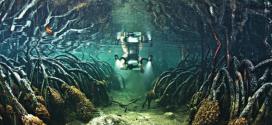
Only possible during high tides, diving in this environment
is an inimitable experience, unlike any other in the underwater
world. Beams of sunlight pierce the water, contrasting with the
dark shade among roots. Along forest edges, curved prop roots
support sponges, bivalves, barnacles, tunicates and even a few
corals. Entering narrow creeks that wind deep into the forests,
divers can explore an immensely different tropical environment
than the ones commonly advertised. Juvenile great barracuda,
mangrove snapper, mullet and archerfish dart silently into
the thickets of roots as divers’ bubbles disturb the water.
Amphibious mudskippers cling to tree trunks. Juvenile bluefin
trevally hound silversides, which flow by schools of hovering
orbiculate cardinalfish, which remain absolutely still among the
dim shadows. Above the waterline, drooping branches covered
with mosses, orchids, ferns and bromeliads arch over placid
creeks whose smooth surfaces conceal unexpected marine
diversity. But there is more to these habitats than their alien
aesthetics; they are critical contributors to the health of other
equatorial ecosystems.
These fringing forests grow along meandering coastlines
and act, in part, as intricate filters, keeping sediment
runoff generated on land from drifting onto and slowly
smothering nearby coral reefs. Mangrove canopies shield
the shallows from direct sunlight, moderating temperatures
while contributing oxygen, absorbing carbon dioxide and
sequestering carbon. They produce organic compounds, a
104
|
FALL 2011
Flooded Forests
Mangrove forests are a
vital component of the
aquatic ecosystem.
T E X T A N D P H O T O S B y E t h a n D a n i e l s
WATER PLANET
104-105_Water_Planet_Fall2011.indd 104
10/13/11