www.alertdiver.com
|
105
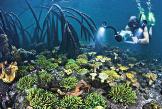
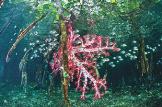
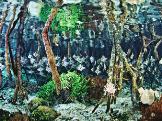
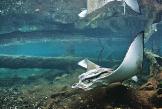
source of food for bacteria, gastropods,
crustaceans and a variety of fish. Many
fish and invertebrates divers are used
to viewing on reefs, such as pipefish,
barracuda, snapper, sharks, rays,
sponges, corals, crabs and tunicates,
use mangroves for refuge, feeding
and breeding. Research performed in
Palau indicates that up to 70 percent
of the local commercially important
fish spend at least part of their lives
within mangrove habitats. Most likely
due to the availability of shelter and
prevalent food, recent studies have
shown habitats in close proximity
to mangroves have at least twice the
fish abundance and species richness
compared to those more distant. In
addition, hundreds of bird species are
known to use the habitat for nesting
and feeding. Mangrove forests, sea-
grass beds and coral reefs form what
has been aptly dubbed by Marcus
Sheaves of James Cook University an
“interconnected habitat mosaic.”
Continually in flux, mangroves
are able to grow and maintain
communities of marine and terrestrial
organisms in equilibrium as long
as human interference isn’t drastic.
Joseph E. Armstrong, professor of
botany at Illinois State University,
states, “Mangroves are certainly
the most misunderstood and most
threatened of all types of tropical
forests. People just don’t understand
that coastal fisheries depend on
mangroves for productivity and as
the breeding grounds of many ocean
species, so when mangrove forests are
destroyed to construct shrimp ponds,
a common situation in Southeast Asia,
people are robbing Peter to pay Paul.
Though mangroves protect coastal
areas from severe storms and tsunamis,
these forests are widely viewed as
waste areas to be cleared away. How
many more incentives do governments
need to institute protection for
mangroves? Unfortunately, the voices
of developers saying ‘progress’ and
‘profit’ sound loudly in political ears.”
Like all of Earth’s ecosystems,
mangroves are at risk from climate
change and associated sea level rise
but other anthropogenic pressures are
most threatening in the near term.
Clearing, overharvesting, overfishing
and pollution upset the ecological
balance of mangrove food chains and
alter local communities for the worse.
The Future of Forests
The key to mangrove forests’ future
is for researchers, fishermen and
divers to convince decision-makers
worldwide that the forests are vitally
important to coral reefs, commercial
fisheries, coastal protection and even
tourism. Although it may be possible
to put a dollar value on mangroves,
their ecological importance is
much greater. Just as coral reefs are
imperative for their role in fisheries
and as carbon sinks, mangroves are
no less significant. They play a role
that protects and connects land
and sea and thus deserve stringent
legislative protection in all countries.
The Mangrove Replenishment
Initiative (MRI), begun as a local
project in Florida but now a global
program, could make a positive
difference around the planet through
education and replanting projects.
It is apparent that conserving and
effectively managing large swaths of
this extraordinary habitat is essential to
a healthy, ocean-covered world.
The ecological and evolutionary
messages conveyed by the colors and
fragrances of flooded forests can be
divined only by thorough observation
and exploration. The utility of these
forests is as extraordinary as their
beauty. Divers who take the time to
observe first hand a mangrove, or
indeed any living ecosystem, will be
rewarded with a distinctive and often
breathtaking experience. Seen from
the inside, mangroves are a series of
marvels, where intermingled organisms
and habitats have made the most of
where land and water unite.
AD
What Can You Do?
Want to help preserve the mangrove forests?
• Get interested in mangroves, and learn
as much as you can about them.
• Swim and dive within them, and see
their uniqueness for yourself.
• Be aware of your food’s origins. Avoid
shrimp raised in farms in former
mangrove areas.
• Become involved. Visit www.mangrove-
actionproject.org and check out the
Mangrove Action Project’s international
work and events.
104-105_Water_Planet_Fall2011.indd 105
9/29/11