MEMBER TO MEMBER
“
I
had a mask squeeze,” I told my husband
at the end of a dive. “But it was just a
little one.” I dutifully checked my eyes
for the telltale broken blood vessels that
scare us silly in photographs, saw none and
promptly forgot about the event. Even when
I developed eye problems in the days that
followed, the memory of the momentary
squeeze was ancient history. I am an experienced
diver and can’t begin to count the number of
times I’ve relieved a slight tightness in my mask
with a small exhalation. It was no big deal.
As it turned out, this time was a big deal.
Te day after the “uneventful” dive, I felt a
strange pressure in my eye. On the second day, the pressure
increased, a redness began to appear, and I developed an
intense sensitivity to sunlight; any hint of it felt like a hammer
hitting my eye. Diving was obviously out, which would be
disappointing under any circumstances for me, but this trip was
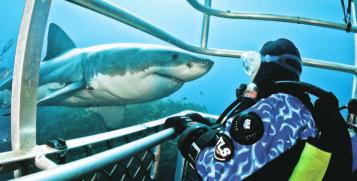
to South Australia to dive with the great whites. Sharks were
circling the boat, and I was stuck in the salon, held prisoner by
my sunglasses. Te disappointment was bad enough, but now I
had an increasing uneasiness on top of it. What was wrong?
Building bad weather and a growing concern for me brought
the boat back to port. Te local eye doctor diagnosed uveitis,
an infammation and irritation of the uvea, the middle section
of the eye. He said the cause is often unknown, although
sometimes it’s due to trauma. He asked if I thought it could be
related to the diving I’d been doing, but I said no. He didn’t use
a key phrase we listen for — “pressure trauma” — so I didn’t
connect the dots. Uveitis is serious, especially if left untreated,
and I was given two prescription medications. Happily, the
medication worked, and I experienced no long-term efects.
I checked in with my local ophthalmologist upon returning
home, and I was told uveitis had a number of causes, one of which
might be “pressure trauma.”Te doctor asked if I’d experienced
any kind of pressure event, and the whole memory of that feeting
moment returned. I remembered the whole sequence: my mask
felt a bit loose; I adjusted it; I recognized immediately it was then
way too tight; I exhaled
into the mask; I felt
the pressure release; I
continued my dive. It was
so routine I’d forgotten
all about it; I didn’t even
remember I’d mentioned it to my husband.
So why am I sharing this story with the DAN community?
Because the forgettable few seconds during which I gave
myself the world’s tiniest mask squeeze is the kind of thing
that can happen to any diver. I didn’t take it seriously enough
to associate it with later problems. I was lucky enough to get
treatment quickly, and I missed only a few dives. Untreated, I
might have had a much more serious outcome.
Divers, please connect the dots: Pay attention to every
detail on your dive, and do your best to remember and record
them. Don’t ignore any symptoms you develop between or
after dives, and never assume they are unrelated to feeting
moments underwater. Tey just might be.
AD
Connecting the Dots
Every detail can prove important.
98
|
SUMMER 2011
106
|
FALL 2011
Tips, advice and updates from your fellow divers
B y S u s a n S c a r l e t t
Do you have tips, advice, travel strategies, dive techniques, lessons
learned or other words of wisdom to share with your fellow divers? Alert
Diver wants your story! Email it to M2M@dan.org, or mail it to “Member
to Member,” c/o Alert Diver, 6 W. Colony Place, Durham, NC 27705.
SHARE YOUR STORY
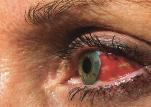
Mask squeeze can cause a
subconjunctival hemorrhage,
resulting in a blood-red
discoloration of the eye.
106_Member_to_Member_Fall2011.indd 106
9/30/11