L
ike many new things, when enriched air, or nitrox,
was first introduced to the recreational diving
community, it was met with a healthy dose of
skepticism. Concerns about its viability, its use
and divers’ safety while breathing it created myths and
misconceptions about “voodoo gas” that are still heard today.
Despite the supernatural nickname, nitrox has increasingly
gained acceptance since its adoption by recreational divers,
as it proved to be not a magical potion, but a valuable tool
for those who know how to use it.
Who invented it?
Many think of nitrox and other mixed gases as relatively
new, since they have been used in the recreational diving
community for only the last 20 years or so. But nitrox has
actually been around and in use for several decades. Both the
U.S. Navy and commercial diving companies have employed
it since the 1950s.
In the late 1970s J. Morgan Wells, then the director of
the National Oceanic and Atmospheric Administration
(NOAA) diving program, proposed procedures for diving with
oxygen-enriched air and creating a breathing gas mix known
as NOAA Nitrox 1, or NN32, named for the percentage of
oxygen in the mix. The gas mix was developed based on
two criteria: a maximum operating depth of 130 feet and a
maximum oxygen partial pressure of 1.6 atmospheres absolute
(ATA). For years, the NOAA guidelines were the standard
when it came to enriched air. In 1985 Dick Rutkowski, retired
NOAA diving program training director, developed the first
nitrox training program for the recreational diver.
How is nitrox made?
Simply stated, nitrox is made by either combining or
separating gases. While this might sound contradictory,
it’s really just a matter of method. The two most common
methods for manufacturing nitrox are partial pressure
blending and the membrane method.
Partial pressure blending adds small, controlled quantities
of pure oxygen to compressed air to achieve the desired
mix. This is much like adding small quantities of very hot
water into a stream of cold water to achieve warm water.
It takes good control, but done properly it can be effective.
The membrane, or gas separation, method employs a
semipermeable membrane to separate the nitrogen from
air, creating a breathing gas with elevated oxygen content.
Both systems achieve the same result: a breathing gas with a
concentration of oxygen higher than the normal 21 percent
and a concentration of nitrogen lower than the normal
78 percent.
Not for deeper depths
While it is less common to hear today, when nitrox was
first introduced to the diving public it had the reputation as
a “deep diving” gas. Ironically, exactly the opposite is true.
Because of the elevated oxygen levels, there are maximum
operating depth (MOD) limits on nitrox. Exceed those depth
limits and the risk of seizure from central nervous system
oxygen toxicity is too high.
Dalton’s law states that the total pressure of a gas is equal
to the sum of the pressures of its component gases. MOD
limits are predicated on maximum partial pressures, the
pressures exerted by specific component gases. While the
percentage of any component within a gas mix doesn’t
change during a dive, the pressure exerted on it does as
a function of depth. The recreational scuba community
generally recommends a maximum oxygen partial pressure
of 1.4 ATA; this is exceeded on air at approximately 198 feet,
but when the composition of the breathing gas is changed,
adjusted MODs are needed. Based on the 1.4 ATA limit, a
nitrox mix with 32 percent oxygen has an MOD of 112 feet,
and 36-percent nitrox has a maximum depth of 95 feet.
Why use it?
Given the role nitrogen plays in certain concerns for divers,
including nitrogen narcosis and decompression sickness
(DCS), it’s easy to see why reducing one’s exposure to it
might be appealing. By reducing the amount of nitrogen
in the breathing gas and replacing it with a gas the body
108
|
FALL 2011
GEAR
Nitrox
A valuable tool, not a magic potion
T e x t B y E r i c D o u g l a s / p h o t o s b y S t e p h e n F r i n k
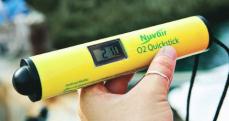
Part of nitrox training is learning to analyze
the gas within a scuba tank. Most dive
operators require the diver using the mix to
analyze it before diving with the cylinder.
108-109_Gear_Fall2011.indd 108
10/13/11