metabolizes anyway, nitrox can lower the risk of DCS or
even safely extend a diver’s bottom time, but it’s important
to realize both cannot be done at the same time.
The decreased risk of DCS comes from a fairly simple
concept: By reducing the amount of nitrogen in the gas mix,
the diver absorbs less nitrogen into his tissues. Compared
to the risk the diver would face diving the same profile on
air, DCS risk is lower using nitrox, though the risk is not
eliminated completely. To take advantage of the increased
safety margin, divers can simply plan a dive as though using
air and execute the dive using nitrox, though the MOD of
the actual gas mix used must be observed.
Increased bottom time comes from the equivalent air
depth (EAD) principle. Dive tables and computers calculate
no-decompression limits using the partial pressure of
nitrogen in breathing gas. When the percentage of nitrogen
(and as a result, its partial pressure) is reduced, this provides
the equivalent of breathing regular air at a shallower
depth. In other words, you can dive at a given depth on
nitrox with the physiological consequences of diving at a
shallower depth on air; diving 32-percent nitrox at 110 feet
is equivalent to diving air at 90 feet. So when calculating
dive times using a dive table or dive computer, a diver can
calculate the dive as if it is to a shallower depth, thereby
extending bottom time.
Conclusions
Today, nitrox mixes are readily available and prepared across
a range of concentrations. It has a lot to offer divers, but it
isn’t magic; rather, it’s a useful tool that provides benefits
if used correctly. When diving according to air tables or
using the air setting on a dive computer, nitrox can reduce
decompression stress on a diver. When used with an
equivalent air depth, this safety margin is lost, but bottom
time can be extended.
Nitrox is becoming more popular and accessible to
recreational divers all the time, but it is not something to be
taken lightly. It requires special training to be used properly
and safely, so before you dive with it, be sure to get the
necessary training and gain the appropriate certification.
AD
www.alertdiver.com
|
109
How do you know
it’s nitrox?
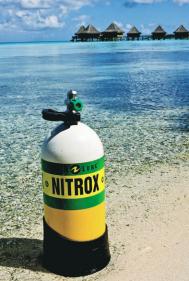
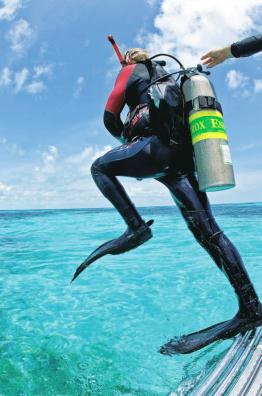
Scuba tanks filled with nitrox are designated with nitrox
decals, along with labels noting the mixture contained
in the tank. EAN32 is nitrox with a 32 percent oxygen
concentration, EAN36 contains a mixture of 36 percent
oxygen and so on.
108-109_Gear_Fall2011.indd 109
9/29/11