FROM THE SAFETY STOP
//
L E T T E R S F R O M M E M B E R S
Letters
JUDGE NOT
The “Member to Member” (“Adapting
or Indolent,” Summer 2011) column
really hit home with me. Thousands
of divers appear to be “normal” but
require assistance in, out and around
the water. I had abdominal surgery
several years ago and went ahead with
a preplanned trip to Bonaire on the
condition I do no heavy lifting. My
husband, who is not a diver, went
along and did all the lifting, carrying
and schleping of dive gear for my shore
diving. I had a wonderful time with no
incidents, but my poor husband was
accused of being my “anchor boy” and
worse. I would not have completed one
dive without his help.
Thanks to advancements in training
and easing of requirements, many
people who could never dive before
are now enjoying our underwater
world. As the article says, make sure
you know before you judge.
— Carol Cox, via email
Ernie Brooks
The piece on Ernest Brooks … loved
it! Those images are as powerful today
as when I first saw them many years
ago. Great to read about the history
and being limited to 12 frames. [It
was a] nice flow in tying the past to
the present.
— Richard Herrmann, via email
A Disturbing Trend
As a relative novice to diving and a
practicing physician, I read with some
degree of alarm your article regarding
the decreasing availability of hyperbaric
chamber facilities for emergency
treatment of acute decompression illness
(“Expert Opinions,” Summer 2011).
If what you write is true and
true for the reasons stated, it is a
disgrace to the entire hyperbaric
medicine community. If recreational
diving has truly become as popular
as the statistics suggest, the diving
community at large must have some
clout on this issue. If, as your article
suggests, it has reached the point
of crisis, it should be addressed as a
crisis, with particular attention to what
recreational divers at large can do to
work toward resolving it.
— Dr. Steve Alcuri, Frederick, Md.
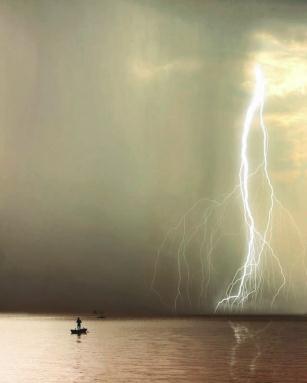
LIGHTNING ENLIGHTENMENT
I appreciated Brian Harper’s article on
lightning (“Field Medicine,” Summer
2011). As the owner and safety officer of
a commercial diving firm, I have made it
a standard operating procedure to secure
diving operations at the first sound of
thunder. As a young man working on a
jack-up barge off the Delaware coast, I
witnessed the effect of a lightning strike
on our barge. The diver was fine, but the
diver’s telephone was fried so we didn’t
know his condition until we brought
him up. The crane operator who was
12
|
FALL 2011
10-13_Safety_Stop_Fall2011.indd 12
9/29/11