DIVE FITNESS
The
DAN
Guide to Healthier Diving
Muscle is Metabolic
Burn extra calories
even while you sleep.
T e x t b y J e s s i c a B . A d a m s , P h . D . ,
a n d S t e p h a n i e N . D e l T u f o , B . A .
P h o t o s b y S t e p h e n F r i n k
To avoid an increased risk of decompression sickness, DAN
®
recommends that divers avoid strenuous exercise for 24
hours after making a dive. Always make sure that you have
medical clearance to exercise during your annual physical
exam or following any changes in your state of health.
NOTE
B
uilding muscle is a great way to boost your metabolism and
ward off fat storage. The higher your metabolism, the more
calories you burn throughout the day regardless of activity.
You even burn more calories while sleeping. Other health
benefits of strength training to increase muscle mass include greater
bone density, decreased risk of lower back pain and functional
independence in later years.
Having more muscle also allows you to perform physically with greater
ease. Carrying gear, exiting the water and finning against current may
be accomplished with less effort, possibly improving air consumption
during dives. Poor muscle performance due to muscle fatigue or decreased
muscle function is a potential cause of distress in diving. So improved
muscular strength will improve performance, delay fatigue and increase
safety by preserving extra energy for unforeseen circumstances that might
arise near the end of a dive. As you increase your muscle mass, you will be
able to participate more comfortably in higher intensity physical activities
that build more muscles, which in turn burn more calories.
Human bodies evolved to hunt and gather food and so are designed
to conserve energy rather than expend it. This is why we store excess
calories so readily. Unless we make use of our muscles, our bodies are
reluctant to dedicate resources to them; in other words, use them or lose
them. Convincing our bodies to develop muscles is actually quite simple
since our bodies respond to the physical stresses to which they are
exposed. If we repeatedly and progressively provide resistance training
or, to put it simply, pick up weights and put them back down, gradually
increasing the frequency, intensity and duration, muscles will develop.
It does not matter how much or how little strength you have to start,
strength training can benefit anyone. As we age, muscular strength
declines slowly until around ages 40-50, at which time the rate of decline
drastically increases if the full strength of muscles remain unused.
Build muscle by completing the following sequence of exercises to
the best of your ability. Start with a few repetitions and little weight, and
increase both as your body allows.
26
|
FALL 2011
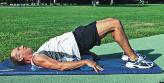
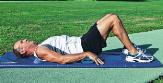
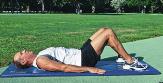
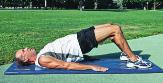
Bridge
Muscles targeted: glutes, lumbar muscles
and hamstrings
1. Lie on your back with your arms by your
sides and your feet shoulder width apart.
2. Bend your knees at a 90° angle.
3. While your feet and shoulders maintain
contact with the floor, lift your torso and
thighs as high as possible.
4. Hold this position, squeezing your glutes
as tightly as possible, before returning to
the starting position.
5. Repeat without resting your torso on the
floor.
Modification: Place a rolled towel under the
buttocks.
26-27_Dive_Fitness_new.indd 26
9/30/11