meet us and transport me to the hospital. Getting me off the
boat and onto the skiff for the short ride to shore proved
the first challenge; the backboard on which they’d hoped to
carry me didn’t fit through my cabin door.
With the help of captain and crew, I completed what felt
like a marathon to reach the skiff. Once at the dock, I made
it (again, with help) to a backboard on shore. On it, I was
carried to the ambulance.
The ambulance was not the transport equipped with
gurney, medical equipment and trained personnel we expect
in the United States. In Chuuk, it meant a van devoid of all
things medical, though it did say “ambulance” on the side,
and it did have a siren and a driver delighted to use it for the
very first time.
To say the 45-minute ride to the hospital was rough is
a gross understatement. The roads were washed out from
months of rain, leaving potholes that could swallow King Kong.
Richie was still with me, and if not for him holding me steady, I
would have fallen off the backboard onto the hard ridged floor.
Not like home
We finally arrived at the hospital, where I was evaluated by
the attending physician. I remained on oxygen and was given
Demerol for pain. My blood pressure was 60/40, so getting
fluids in my system was critical. And that was basically the
extent of the services offered there.
Hospitals in remote areas like Chuuk are not always like
those at home. With no running water and no pillows, blankets
or food for patients, if you want anything resembling a comfort
item (including food), it must be brought with you or to you. I
asked to go to the bathroom, and they took me to a stall with
a toilet but no seat; the floor was so dirty I didn’t know if I was
stepping in human waste. With the exception of (thankfully)
the room I occupied, there was no air conditioning.
Communication was problematic, as no one spoke English.
Valuables like your passport and wallet are simply placed on a
chair next to you; I was too tired and drugged to know or care
if anything was stolen. Having someone to look out for you
(like I had Richie, who watched over me like family) is vital.
I’d arrived at the hospital around 7 p.m. on a Tuesday, and
we received word from the local chamber it had no available
personnel to treat me. But unknown to me, the Odyssey’s
captain had contacted DAN
®
when it was first evident I
needed help. By Wednesday afternoon, DAN had arranged
for a medical transport to fly me to the Dive Locker on the
U.S. naval base in Guam. A paramedic and registered nurse
arrived with the air transport, looking like two angels in their
professional attire. They settled me in, and we embarked on
the short flight to Guam.
An unusual condition
The Dive Locker is a state-of-the-art U.S. Navy facility, and
the personnel there are top notch. By the time I arrived,
it had been more than a day since I’d last eaten, and I was
immediately given what little food they had on hand before
they sent out for more. Their consideration and attention to
small comforts proved to me I was in the care of people who
wanted to make me well.
I spent five hours in the chamber completing a Table 6
treatment. By its end, my back pain was gone, the skin
marbling subsided, and I’d regained some feeling in my leg.
From there I was released to the hospital in Guam.
I continued receiving fluids during my evaluation, but tests
revealed my muscles were breaking down, a condition
known as rhabdomyolysis. Caused by traumatic events to
the body, the painful condition releases protein enzymes
into the bloodstream, filtering into the kidneys. If it
continues for any length of time, the kidneys can shut down.
To counteract this, I was injected with massive amounts of
fluids in the hope I could flush out the enzymes and stop
the muscle breakdown. After four days, lowered enzyme
levels finally indicated the rhabdomyolysis had ceased. My
condition improved, I was released from the hospital.
Lessons learned
The doctors who treated me believed dehydration and
fatigue played a major part in my getting bent. I was ordered
out of the water for six to eight weeks, and it’ll take time to
build back my stamina, but it looks like I’ll recover just fine.
36
|
FALL 2011
RESEARCH, EDUCATION & MEDICINE
//
D A N WA S T H E R E F O R M E
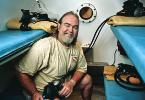
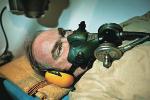
Mace’s symptoms finally resolved after
hyperbaric chamber treatment at the
U.S. Navy Dive Locker in Guam.
SHARE YOUR STORY
Has DAN been there for you? Tell us about it at ThereForMe@dan.org.
35-37_DAN_Was_There_Fall2011.indd 36
9/30/11