M
ost divers who have been certified for any length
of time find themselves, at some point, interested
in wreck diving. In part, this is because wrecks
can be found in just about any body of water
— from quarries, where old propeller planes and school buses
entertain us; to rivers and lakes, where fresh water can preserve
even wooden ships for ages; to the seas and oceans, where the
sunken remains of humans’ seafaring history are found. Divers are
fascinated by the windows on the past wrecks can be; each one is
a museum of both human history and aquatic ecology, frozen in
time but alive. Whatever your interest in wreck diving, it’s safe to
say the knowledge, training and expertise needed to dive wrecks
are as unique as the experience itself.
I have often been asked what it takes to dive wrecks safely or
what training a diver should pursue to enjoy wreck diving, and
my answer is always, “It depends.” Many dive professionals have
heard the following stated earnestly by an overzealous new diver:
“I was hoping to dive the Andrea Doria or the Britannic — what
do I need to do?” My answer to this statement is also consistent:
“How many years were you planning to train for the dive?” It takes
a while to work up to a low-visibility, cold-water, high-current,
offshore, custom-blended-mixed-gas wreck dive; you have to
master each component before trying to tie them all together.
Strong Currents, Big Waves
Let’s face it, many wrecks are on the bottom because the surface
conditions in the area were, at some point, less than ideal. Some
of the most interesting historical wrecks are situated in especially
challenging dive conditions. Divers wishing to visit these wrecks
should be comfortable with high current and surge. This means
lots of experience diving in the open ocean and good physical
fitness. A giant stride from a pitching boat into turbulent waves
can be daunting, but getting back onboard at the dive’s end can
actually be more physically challenging — and dangerous. You
need to be able to haul yourself, your gear and 30 extra pounds
of water weight back up the ladder as well.
Every effort should be made to have equipment that is proper
for the dive and streamlined to reduce drag, thereby reducing the
effort required of the diver. Think you’re in great shape and this
doesn’t apply to you? The fact of the matter is you are fighting
Wreck Exploration
Tips for diving safely into maritime history
T E X T B y R i c h a r d W a l k e r , M . D . , M . S . , a n d J o e C i t e l l i / P h o t o s b y J o e D o v a l a
38
|
FALL 2011
RESEARCH, EDUCATION & MEDICINE
//
A D V A N C E D D I V I N G
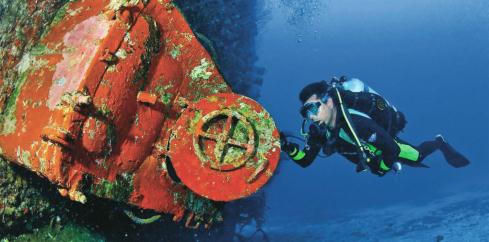
Training in wreck diving opens doors to
new adventures beneath the waves.
Here a diver explores the aft hatch of the
USS Anderson near Bikini Atoll.
38-40_Advanced_Diving_Fall2011.indd 38
9/29/11