them in nearly invisible line that’s hard to cut and invariably
has something sharp and rusty at one end. Newer abrasion-
resistant line is all but impossible to cut without shears or
blunt-ended trauma scissors, which I always carry. These are
made of high-grade stainless steel, weigh almost nothing and
can cut a penny in half. Loose netting from fishing vessels is
also found covering wrecks in deeper waters. Entanglement
is a leading cause of experienced technical diver deaths — it
can happen to anyone. Be prepared for it with proper cutting
tools. Most experienced divers have more than one handy in
case they drop one or are entangled in a manner that prevents
access to their primary tool.
Inside a wreck there are other concerns: metal rusting to
razor-sharp edges, rooms turned to impossible and disorienting
angles, furniture lying in jumbled heaps and wiring that your
shears won’t cut. Insulation may fall from a ceiling, blocking
a passageway while simultaneously dropping the visibility to
millimeters, or an errant fin stroke might mix the paint on the
walls with the water in the room, giving it the consistency of
blue milk and forcing you to find a way out by fingertip. A 700-
pound goliath grouper could suddenly realize you just swam
into the room he was napping in — and that you are floating
in front of the only exit. All these are real-world pop-quizzes I
have enjoyed in the past. It turns out training for the worst-case
scenario pays off every now and again, so pay close attention
to your carefully chosen wreck instructor. Wreck diving can
be done safely but requires training, experience and the right
equipment. Don’t shortcut any of these prerequisites, or you
risk failing one of those quizzes.
Getting Back On board
So you got trained, practiced, got your gear up to speed, and
your buddy calls. He has booked a trip out to that wreck
you’ve been chatting about forever. A few days later, you
drop down into the depths, find the wreck, explore it and are
ready to ascend. The current has picked up, so you and your
buddy blow lift bags from the top of the structure before you
drift off into the wild blue yonder. You release the bags from
a down-current rail to ensure they, and eventually you, don’t
get entangled in the superstructure during ascent. Maybe
you racked up a few minutes of planned decompression
— no drama, you are trained and equipped for it. Twenty
minutes later you have completed the dive and are on the
surface — more than a mile away from the boat in a three-
knot current.
If you didn’t anticipate the possibility of being alone in
the open sea, your dive planning was, ahem, incomplete.
The latest whiz-bang gadgets are nice to have, and there are
dives where an emergency position indicating radio beacon
(EPIRB) is a great idea, but you always need some basic short-
range signaling devices. Everyone should carry and know
how to use a signal mirror and whistle. Flares, dye and an
inflatable tube usually make it into my kit for serious offshore
excursions. Ask your wreck instructor how best to carry
them. One system, an old wreck-diver trick believed to have
been introduced by Billy Deans, is an OSC (“oh shoot can” or
something like that). An OSC is made up of an old canister
light with a solid lid that can hold all these items plus a small
EPIRB and is watertight to depths far below your planned dive
depth. If I am going way offshore to dive in a six-knot current
like the Gulf Stream, I keep mine next to my light can on my
belt. There’s no telling where you will be after an hour of deco
on the end of a bag and string. If you’ve never spent a few
hours drifting waiting for the boat, it’s memorable. Oh, I also
carry a small tube of high-SPF sunscreen in my can now, too;
there’s no teacher like experience.
AD
RESEARCH, EDUCATION & MEDICINE
//
A D V A N C E D D I V I N G
40
|
FALL 2011
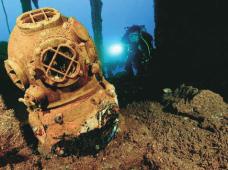
U.S. Navy Mark V diving
helmet, USS Saratoga,
Bikini Atoll
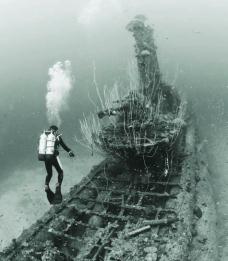
USS Apogon, Bikini Atoll
38-40_Advanced_Diving_Fall2011.indd 40
10/11/1