




www.alertdiver.com
|
71
Erdmann, especially, has taken a very organic, whole-
system approach to conservation and has tried to integrate
the biological, geopolitical, ecological and economic aspects,
especially as they relate to the needs of the Seascape’s human
population, into an overall conservation plan. One of our
primary missions has been to discover new dive areas, thus
bringing tourism to the Seascape’s far-flung coastal villages.
Between the Raja Ampat guide and the new Seascape guide,
we have identified more than 200 sites, including more than
50 new ones we hope will turn tourism into a viable asset for
local communities throughout the region.
Erdmann and Allen are not your typical field biologists.
They call each other unprintable names, play practical
jokes, stay up late caring for their specimens and writing
reports, and then they wake up early to count fish. These
are the guys who coined the terms “species factory” (Triton
Bay), “the bull’s-eye of marine biodiversity” (Raja Ampat)
and “evolutionary cauldron, the terrestrial equivalent of the
Galapagos” (Cenderawasih Bay).
They also came up with the idea for the Blue Auction, a
black-tie event hosted by Prince Albert of Monaco, where rights
to name newly discovered species were auctioned to some very
wealthy people. Allen says, “After Mark and I collected a couple
of new species of walking sharks, one from Cenderawasih Bay
and one from Triton Bay, we were sitting around — I’m sure a
beer or two were involved — and Mark brought up the idea of
making some money from naming these animals that could be
plowed back into saving them. One of our notions was to sell
the naming rights. At first it was just a pipe dream, but it had
been done before so there was a precedent.” The Blue Auction
raised more than $2 million for things such as field stations,
floating ranger stations and scholarships for Indonesian marine
science students. Importantly, the money was recirculated to
where it mattered most: the Bird’s Head.
Erdmann and Allen taught us how nongovernmental
organization (NGO) funding is prioritized and why marine
surveys are crucial to preservation. It actually unfolds quite a
bit differently than we originally believed. The science has to
happen first; without ongoing scientific characterization there
would be no way to assess correctly which areas to target and
preserve. During the scientific characterization period, NGO
staff work with the local population to gain their trust and
impart to them a sense of ownership and responsibility.
Surveying the Sites
What actually happens during these assessment surveys?
How do the scientists and we figure out where the most
fish and coral live, what they are and how a site should be
dived? This is the fun part. It’s not like a liveaboard, where
the standard routine is breakfast, dive, second breakfast, dive,
lunch, rest and dive again. We grab something to eat and
everyone gets in the water as quickly as possible. Often, we
hardly communicate with each other again until evening.
The science contingent’s plan usually takes Erdmann to
significant depths; even in remote areas the prime sites for
hunting new species tend to be deep. He stages tanks and
reluctantly submits to hours of decompression time. His
ability to identify fish in the dark depths is amazing. If he
finds something interesting he’ll bring it to Allen, who stays
shallower to count species and photograph. Both of them
have an encyclopedic knowledge of fish, including their
Latin names, habits, habitats and more. Imagine being on a
boat with two guys who can answer all your identification
questions and then tell you the story of when and where they
discovered one of the fish you just asked about.
While Erdmann, Allen and any other scientists who are
diving with us go off to their respective study sites, Burt and
I hook up to powerful scooters that allow us to survey 10
times the area we could using fin power alone. The biggest
challenge is deciding where to start. We study charts, talk
to anyone who has been in an area before us and rely on
our instincts. Using a scooter while holding a camera is a
bit tricky, so if one of us finds something extraordinary, we
go back to the liveaboard and grab the appropriate housing.
AND THEN T E L L YOU WHEN AND WHERE THE Y F I RS T D I SCOV ERED THE F I SH .
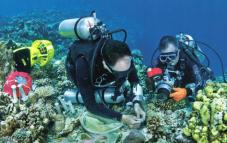
Left: Mark Erdmann and Gerry Allen collect
new species in Cenderawasih Bay. Right:
Jones poses over a sea fan encrusted with
new growth, Pisang Islands. Opposite: Pristine
beach and shallow reef, Wagmab Island
66-73_Birds_Head_Fall2011.indd 71
10/12/11