




Usually stopping only to charge scooter batteries and fill
tanks, we check our GPS readings and make careful notes
about the sites, including how we dived them and what
we saw. When we do get a chance to take a few shots, we
have to do it right the first time. Everyone involved in these
surveys has an agenda, and none of them include going back
to an already-surveyed site because a lens cap was left on.
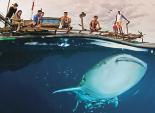
When we were in Cenderawasih Bay last year, our primary
goal was to find and interact with whale sharks that feed under
lift-net fishing platforms called bagans, found throughout the
southern part of the bay. Locating animals as big as whale
sharks was easy, but as we worked our way around their feeding
grounds, other fish identifications stumped us more than they
usually do. We constantly saw fish that seemed out of place
or were colored a bit differently. When we photographed a
Burgess’ butterflyfish in about 20 feet of water, we couldn’t
believe what we were seeing because they are usually found
deeper than 100 feet. “That’s the beauty of this place,” Allen
explained. “Eons ago, major tectonic plate movement repeatedly
blocked the mouth of the bay. After sea levels dropped during
the Pleistocene, shallow reefs died off and only deeper reefs
survived, but now in shallower water. Normally deep-dwelling
species like Burgess’ butterflyfish stayed shallow even after
sea levels rose again because the size of the bay limits water
movement and outside species recruitment, meaning little
competition for the shallower niches.”
If Cenderawasih Bay is a fish nerd’s paradise complete with
weird variants and the largest fish in the ocean, and Raja Ampat
is the marine world’s richest repository of fish and corals, then
what makes Triton Bay a “species factory?” When the first Triton
Bay surveys were conducted in late 2006, scientists were looking
for a “hot spot,” an area of maximum species diversity and
endemism. Allen explained, “This is where all the data I collect
comes in. With this hot-spot data I can tell an organization
where they need to set up their network to capture the whole
of fish diversity. Conservation International has been very
successful using the targeted hot-spot approach to save terrestrial
species, and we are trying to use some of the same philosophies
for saving marine species.”
In 12 days, more than 20 species of
marine life were discovered, more than
70 dive sites were surveyed, and Allen
established a new world record for fish
diversity: 330 species on a single site. We
had a very difficult time pulling ourselves
away from the sites around Selat Iris, especially
Bo’s Rainbow
and
Little Komodo
, because the soft corals and fish life were
some of the most prolific we’ve ever seen. When upwellings
turned the sea Coke-bottle green, we looked beyond the
profusion of color and found a surprising number of frogfish,
unusual shrimp, crabs and mimic octopus.
Like its neighboring Seascape regions, Triton Bay’s
turbulent geological history has affected the evolution of
its marine life. But Triton’s high endemism is most notably
due to the huge volume of fresh water flowing from the
West Papuan mainland into the sea. Most marine larvae
cannot survive in a low-saline environment, and neither
Raja Ampat nor Cenderawasih contain great estuaries like
Triton’s Arguni and Etna bays. Sandwiched between these
two enormous freshwater outflows, Triton’s marine larvae
have developed on cloistered reefs and traveled their own
evolutionary path.
Anointed by storms, caressed by monsoon winds, embraced
by jungles, towering mountains, sandy beaches and rocky
shores, the Bird’s Head Seascape evokes a sense of what tropical
wildernesses must have been like before most of them were
logged, mined, dynamited and relegated to mere remnants.
This is a place where birds of paradise dance in trees, where
endangered turtles nest on secluded beaches, where sharks
“walk” over coral and where divers can get close to manta
rays, whale sharks and more than 1,600 other fish species. We
know there is a risk in developing the Bird’s Head into a world-
renowned dive destination if visitors do not learn to respect
its natural rhythms, including those of its human inhabitants.
And even though we realize the thrill of discovery is ephemeral,
we believe the Bird’s Head Seascape will endure, kept safe and
productive through the coordinated and enlightened efforts of
government, citizens, NGOs and visitors.
AD
I N 12 DA Y S , MORE THAN 20 SPEC I ES OF MAR I NE L I F E WERE D I SCOV ERED .
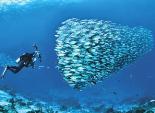
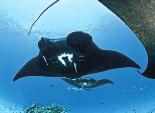
From left: The action at Manta Sandy, Raja Ampat; Jones photographing ox-eye scads in southeast Misool; whale sharks feed under a bagan, Cenderawasih
National Park. Above: A blue-ringed octopus, Batanta. Opposite: Jones photographing a tasseled wobbegong shark, Yanggefo Island
72
|
FALL 2011
66-73_Birds_Head_Fall2011.indd 72
9/30/11