84
|
FALL 2011
Miller MR, Motaleb M (2007). “Scuba divers rinse tanks harbor many microorganisms.” Microbe 2(12): 577.
Olsson DJ, Grant WD, et al. (2008). “Conjunctivitis outbreak among divers.” Undersea Hyperb Med 35(3): 169-74.
Thompson JR, Marcelino LA, Polz MF (2005). “Diversity, sources and detection of human bacterial pathogens in the marine
environment” from Oceans and Health: Pathogens in the Marine Environment, Belkin S and Colwell RR (eds.).
Washburn BK, Levin AE, et al. “Identification of bacteria in scuba divers’ rinse tanks.” Undersea Hyperb. Med 37(4): 233-40.
REFERENCES
Clean and Sanitize
Your Dive Gear
By Daryl F. Stanga, HM1/SCW/DV,
U.S. Navy
Although the risk is considered to be very
small, second stages and mouthpieces
could transmit disease. Divers are
encouraged to disinfect equipment
properly.
Commercial products designed for
cleaning dive gear are widely available.
Make sure to choose a cleaning agent that
does not contain hydrocarbons. If in doubt
about a product’s usability on dive gear,
consult the equipment manufacturer for
recommendations.
To clean scuba regulators, use a scrub
brush to remove any gross contamination
such as mud, dirt, sand, seaweed or saliva
from the regulator. Rinse thoroughly with
fresh water, then spray a liberal coat of
the chosen cleaning agent on and into
the mouthpiece and second stage until all
surfaces are wet.
Let stand for 10 minutes. If the solution
appears to be drying, apply more to keep
the regulator wet for the full 10 minutes.
After 10 minutes, rinse with clean, fresh
water or under running potable water.
If several regulators need to be
sanitized at the same time, or if you
prefer immersion to clean the equipment,
regulators may be immersed in the
disinfectant solution for 10 minutes and
then rinsed in fresh water.
Use the same procedure to sanitize
snorkels and the oral inflation tubes of
BCDs. To clean the BCD thoroughly, pour
several ounces of the solution into the
bladder and agitate for 10 minutes. Then
empty the bladder and rinse with fresh
water.
Before reassembling, allow the BCD to
air dry.
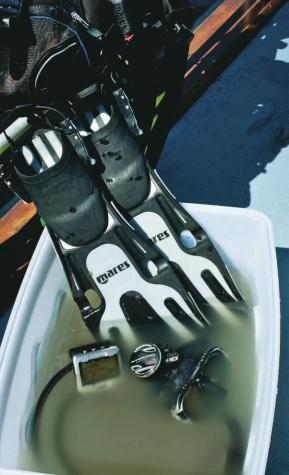
Communal rinse tanks have been shown to concentrate bacteria, so rinse gear that comes in
contact with skin — and especially mucous membranes — under running water when possible.
80-85_Bacterial_Hazards_Fall2011.indd 84
9/29/11