Basic HTML Version


I
f you don’t already know what eutrophication is,
you soon will. If you’ve been diving recently in the
Caribbean, the Coral Sea or many other places,
chances are you have already beheld the effects of
eutrophication with your own eyes.
When nutrients are added to a lake, river, estuary, lagoon
or ocean, they invariably enhance the growth of some life
forms (usually algae and sponges) at the expense of others;
this is eutrophication. Eutrophication is the leading example
of human activity degrading marine habitat in coastal waters,
and it is always traceable to agricultural runoff, sewage
(treated or otherwise) or both. Today the term is most
frequently used to describe the effects on coral reefs from two
groups of nutrients: phosphorus and nitrogen compounds.
Some problems reefs face, such as storm damage, are the
result of natural causes. Others are the result of human activity;
overfishing, sedimentation from runoff and acidification are
prime examples. When these stress factors are present, even a
modest increase in phosphorus and nitrogen can spell the end
of a coral ecosystem. Eutrophication is usually the final step
in a shift from complex reef communities — desirable for so
many human endeavors and economies — to simple, much
less diverse communities. Simply put, a predominantly coral
community becomes a predominantly algae community.
Natural stressors such as coral bleaching and storms can
be thought of as the forest fires of the reef. As bad as it looks
right after the fire, the bleaching or the storm, the environment
eventually benefits. Nature tends to periodically thin out areas
choked with undergrowth, which stimulates resilience and
new growth. Even coral reefs recover after a few years, possibly
developing to even higher levels of complexity and community
than before —provided the environment is fundamentally healthy.
WATER PLANET
104
|
SPRING 2012
Eutrophication
The arrow to the heart of coral reefs
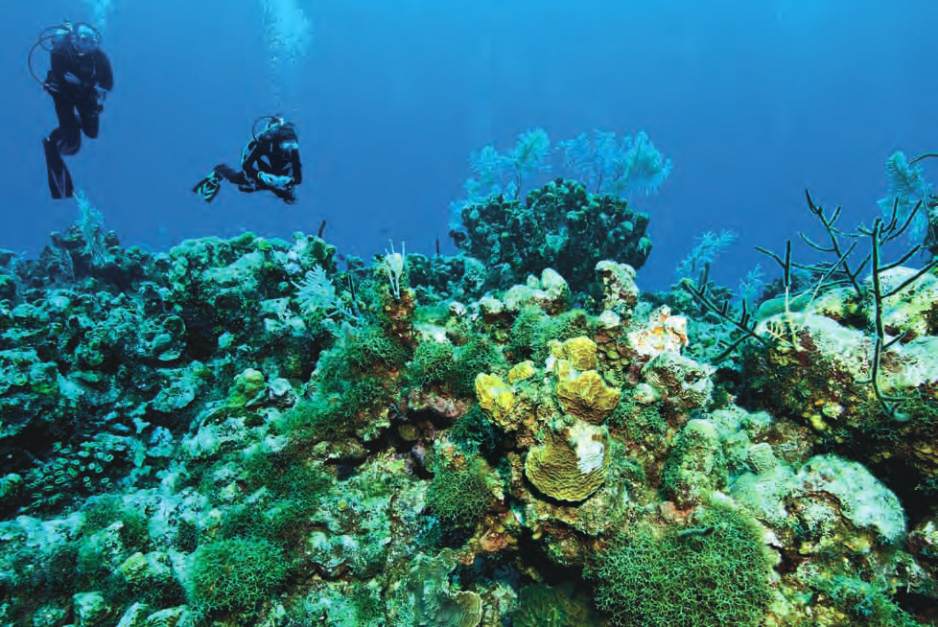
Eutrophication is the growth of some organisms, such as algae and
sponges, at the expense of others such as coral. It results from
nutrients introduced into the marine environment by agricultural
runoff or sewage. Opposite, from left: A variable boring sponge
with the host coral cut in half to show the internal portion of the
sponge occupying holes it bored in the coral skeleton. A hawksbill
turtle forages for sponges on a macroalgae-covered reef. A spotted
scorpionfish perches in a field of macroalgae.
B y W I L L I A M G O O D W I N
S T E P H E N F R I N K