Basic HTML Version


www.alertdiver.com
|
105
Regime shift
Suppose a storm-tossed reef happens to be in an area that has
become high in phosphates and nitrates. Add additional stress
in the form of declining algae-grazing fish due to overfishing,
for example, and a coral-dominant regime may be replaced
with a new regime. A regime shift is exactly what’s happening
in places where agricultural runoff and sewage are raising
the levels of nutrients that favor the growth of turf algae,
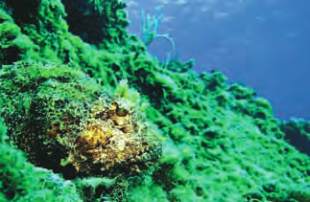
macroalgae and even reef-destroying boring sponges. Algae
and boring sponges are always present on a healthy reef, but
corals and other kinds of sponges can compete and hold
their own as long as the conditions favor their regime. But if
nutrient levels increase and the coral community is weakened
by stress, the invigorated algae and boring sponges will grow
faster, cover newly exposed surfaces and smother living corals.
When such a regime shift takes place, most creatures that
depended upon the intricate and diverse elements found in
the coral-and-sponge regime will leave or die to be replaced
by life forms of the new, less diverse regime.
The elevated phosphates and nitrates that promote rapid
growth of turf algae and macroalgae also encourage the
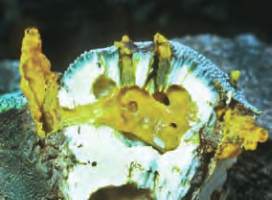
expansion of encrusting and boring sponges, which break down
the calcium carbonate structure of coral into fine powder. Some
species of these destructive sponges have an utterly amazing
capability for bioerosion. In fact, the scientific name for the
Red Boring sponge is Cliona delitrix; the species name delitrix
means “destroyer.” This encrusting sponge advances over hard,
nonliving surfaces at a rate of 2 inches per year, but it moves
twice this fast over living coral. It excavates and burrows deep
tunnels into the very core of a coral colony as it grows. Studies
show that this and similar bioeroding sponges are capable of
removing solid material from the underlying coral at a rate
roughly twice as fast as the coral can grow. Healthy coral
can defend itself against invading larva of these sponges, but
stressed reefs are unable to repel the destroyers.
Klaus Ruetzler, a research biologist at the Smithsonian
Institution, confirms that in many coastal waters of the
world sponges of the Cliona genus are destroying coral
reefs at an unprecedented rate. The rate of reef destruction
due to Cliona is directly related to eutrophication. After
determining the percentage of reef covered by Cliona and
other eutrophic organisms increases with proximity to
sewage outfalls, some scientists have proposed using Cliona
levels as a pollution index.
is RecoveRy possible?
There is hope, and it resides in the seeds of the coral
regime that remain alive within the tangles of algae and
in the water column above the reef. Since each regime
possesses strong elements of the other, there is the inherent
possibility we might still halt this cascading shift from
the regime we want to the one we don’t. About half of
coral reef scientists and administrators are convinced that
with aggressive management and enforcement of existing
and new environmental laws, the regime shift can be
reversed. But the other half, noting obstacles such as the
immense investment needed to reverse even portions of
the eutrophication process, are skeptical about whether the
political will exists to protect sensitive coral realms from the
dangers of human waste and agriculture. Bonaire’s Ramon
de Leon, manager of one of the oldest and most respected
reef protection programs in the world, sums it up when
he says, “I’m optimistic, and I wake up every day thinking
there’s hope, but I also think realistically that the situation is
not good at all.”
Biologists tell us sponges have played an important role
in reef systems throughout time, especially in providing
critical support to reef health during times of biological
stress. Perhaps sponges are more resistant to eutrophication
and other hazards like rising sea temperatures and ocean
acidification than corals are. If so, we could once again see
sponges become the dominant animals on Earth’s reefs
instead of corals. It’s already happening.
AD
solutions
There are practices individuals can adopt to help reduce eutro-
phication: eating locally produced food, using biodegradable
detergents without phosphates, reducing meat consumption and
not dumping waste (even treated waste) into bodies of water.
However, the problem exists primarily at the industrial and gov-
ernmental levels. Governments of Baltic and some Caribbean
nations, where eutrophication is most severe, are beginning to
take steps to address it. Best-management practices for reducing
phosphates and nitrates that enter the seas have been devised.
As sources of agricultural phosphates grow scarcer, market
forces are providing incentive to recover them before they enter
coastal waters. As awareness of eutrophication grows, the hope
is citizens will elect officials with the political will to implement
phosphate and nitrogen remediation on a large scale.
Klaus Ruetz l eR
Wi ll iam gooDWin
Wi ll iam gooDWin