Basic HTML Version


MEMBER TO MEMBER
O
As the zodiac driver lowers the hydrophone
into the green waters of Canada’s Hudson Bay,
we are immediately greeted by a symphony of
high-pitched chirps, squeals, whistles and bell-
like clangs. We listen intently to this otherworldly cetacean
symphony, and the guide tells us there are at least 30 belugas
nearby. With an equal mixture of excitement and trepidation,
I drop over the side of the zodiac into the subarctic waters. My
7mm wetsuit fills with water, my breath shortens to shallow
gulps, and my body recoils from the chill.
“Belugas at 3 o’clock and moving quickly,” shouts the guide.
As a 2,000-pound mother and her gunmetal-gray youngster
approach to inspect the peculiar, snorkel-equipped marine
mammal, I replay the advice from the Vancouver Aquarium’s
marine mammal expert who told me how to identify “happy”
versus “agitated” beluga behavior. “When a beluga contorts its
body into a C-shape,” he said, “watch out.”
I reflect on this as I bob just below the water’s surface,
furtively scanning the horizon for polar bears and tightly
grasping a tow rope. My eyes wide open and my mouth
clamped firmly around my snorkel’s mouthpiece, the zodiac
driver trolls me through Hudson Bay like bait on a line.
As a diver, I had never taken snorkeling very seriously. But
six years ago my 32-year diving career came to an abrupt end
in Belize. I suffered an arterial gas embolism (AGE) without
any obvious cause and spent the better part of three days in
a hyperbaric chamber. I consulted several doctors trained in
dive medicine, who carefully reviewed my dive profiles and
medical history. Based on my discussions with these experts
and the particulars of the incident, I decided to discontinue
compressed-gas diving.
My lifelong love affair with the marine environment,
however, didn’t end in the hyperbaric chamber: I made the
transition from scuba diver (and instructor) to extreme
snorkeler. I’ve experienced many life-defining moments
in the snorkel zone, the unique water-air-land interface
where charismatic megafauna congregate and interact with
humans. I’ve come face-to-mask with charging leopard seals
in Antarctica — so close, in fact, I could inspect their tri-
serrated teeth and count the freckles on their upper palates.
I’ve assisted the Haida Nation with its salmon research
program, running the rivers of Haida Gwaii (islands off the
coast of British Columbia) and counting salmon migrating
toward their ancestral spawning grounds while dodging sleek
black bears foraging for their next protein-rich snack.
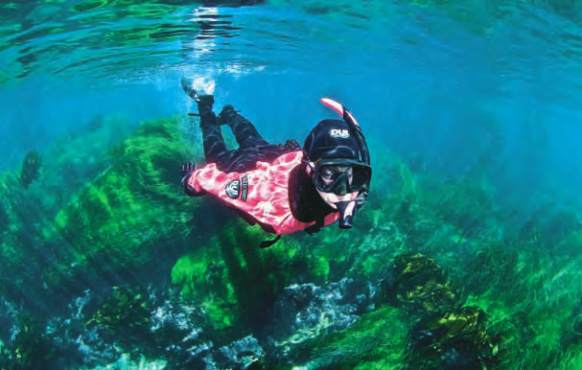
My personal journey into the snorkel zone illustrates
there’s life after diving — or even a parallel life to be found
while you’re still donning tanks. The snorkel zone offers
a magical window onto wonders of the aquatic world
sometimes overlooked by divers. It’s a peaceful place where
bubbles are few and boundaries blur between exhalations
from snorkels and blowholes. Bathed in sunlight, the snorkel
zone provides a full spectrum of light ideal for photography
and videography. Less equipment-intensive than diving,
snorkeling can be a lifelong activity enjoyed by those who
have reached an age where they no longer wish to carry
heavy tanks, and it can introduce the underwater world to
those not yet old enough for a scuba certification.
So whether your best days of diving are behind you or still
to come, there’s something for you in the snorkel zone. All you
have to do is venture there.
AD
Into the
Snorkel Zone
How one diver found life
after scuba
98
|
SUMMER 2011
106
|
PRING 2012
Tips, advice and updates from your fellow divers
B y S U S a N R . E a t o N
Do you have tips, advice, travel strategies, dive techniques, lessons
learned or other words of wisdom to share with your fellow divers? Alert
Diver wants your story! Email it to M2M@dan.org, or mail it to “Member
to Member,” c/o Alert Diver, 6 W. Colony Place, Durham, NC 27705.
SHARE YOUR STORY
A ND Y S A L LMON