Basic HTML Version


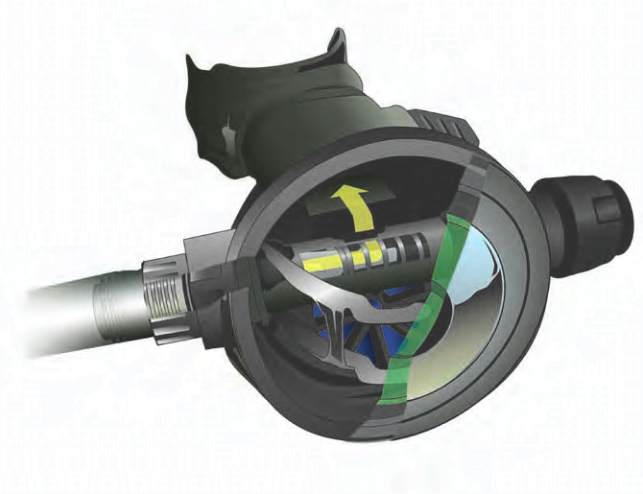

piston back onto its valve seat. As the
diver inhales again, the cycle repeats.
In a diaphragm system there is a soft
cover (like a flexible drum head), which
is drawn inward from the force of the
expanding main spring as the diver
inhales and the IP chamber empties.
This separates the seat seal between
the HP and IP chambers, allowing air
to flow. When the IP chamber fills, the rising pressure
forces the diaphragm outward. This compresses the main
spring and reduces the force exerted onto the seat seal,
closing the air passageway.
BALANCED AND UNBALANCED FIRST STAGES
One of a regulator’s primary functions is to keep the IP as
consistent as possible while dealing with the continuous change
in the supply pressure as the tank is breathed down and the
change in ambient pressure as the diver changes depth.
An unbalanced first stage is susceptible to IP variation as
tank pressure is reduced or as depth changes. Consequently,
as a diver goes deeper or as he breathes the tank down, the
inhalation effort may increase.
A balanced first stage, in contrast, is able to maintain
a more consistent IP regardless of conditions. This is
accomplished through the inclusion of a balance chamber
that uses tank pressure to apply equal pressure to both
sides of the valve head. This results in consistent breathing
performance regardless of depth or air supply.
THE SECOND STAGE
The second stage’s job is to take IP air and step it down to
ambient pressure so the diver can enjoy an inhalation effort
as close to normal topside breathing as possible.
As the diver inhales, pressure in the second stage casing
drops below ambient pressure, which forces the diaphragm
toward the diver’s mouth. This causes it to press against a
demand lever, which allows an inlet valve to open and air to
flow. Upon exhaling, the diaphragm is forced away from the
diver’s mouth, taking the pressure off the lever and closing
the inlet valve. At the same time, the exhalation pressure
forces the exhaust valve open, allowing exhaled air to be
released into the water column.
Like first stages, second stages are either balanced or
unbalanced. Balanced second stages reduce the “cracking
effort,” or the amount of “suck” required to initiate airflow with
each breath. This makes for an easier-breathing regulator.
Some second stages also offer user adjustments that allow
the diver to take a more active role in regulating airflow. The
two basic types are the dive/predive switch (DPD) and the
breathing-resistance knob.
The DPD is primarily a surface adjustment. In essence,
it detunes the regulator by reducing breathing sensitivity.
This is often done through the use of a pivoting vane located
right inside the mouthpiece orifice. When turned at an
oblique angle, the vane deflects airflow, creating turbulence
inside the casing and making the regulator less prone to
freeflow when it’s not in the diver’s mouth.
The breathing-resistance knob is more of an at-depth
adjustment. It enables the diver to alter the breathing effort
based on diving conditions. Dialing “in” exerts pressure
on the second-stage spring. This pushes on the seat,
increasing the effort required to breathe. This can be useful
for minimizing positive pressure when swimming into a
current. Dialing “out” eases pressure on the spring and seat,
making it easier to generate airflow. This can be useful when
descending to deeper depths.
Put it all together and divers have a comfortable and
reliable breathing system that supplies a steady flow of air,
available on demand.
AD
Second Stage
purge button
breating-
resistance
knob
diaphragm
demand
lever
mouthpiece
intermediate-
pressure air
from first stage
ambient-
pressure
air to diver
air barrel
assembly
www.alertdiver.com
|
109
Scuba regulators use a two-step process to deliver
ambient-pressure air to divers: the first stage and the
second stage. The internal mechanism of a regulator’s
first stage may be either a piston or a diaphragm.