Basic HTML Version












www.alertdiver.com
|
13
SHIPWRECK EMPIRE
I just read the North Carolina wrecks
article (Local Diving, Fall 2011) again,
this time on my iPad. It really is a very
good article, and having the links to
the NOAA videos and photos really
enhances the overall piece. The photos
in the article are also very good, and I
especially like the one of the shark herd.
It is just spot on, capturing the feel
of seeing it in person. Overall, I really
think it is one of the best articles I have
read covering the N.C. dive experience.
Thanks for the effort you put into it.
— Dave Sommers, via email
CONTEXT, PLEASE
I have been a DAN member for about
25 years. Luckily I haven’t had to call
on DAN’s services in that time, but
I have always appreciated the useful
information DAN has published that
has hopefully made me a safer diver.
I would like to make one suggestion.
Articles about specific decompression-
illness incidents often briefly state that
the diver concerned has been diving
within acceptable sport-diving limits and
there was no apparent reason for the
hit. Because of the possible link between
dehydration and decompression illness,
I think it would be instructive in these
articles to say something more about
the lifestyle of the diver concerned. For
example, had the diver been drinking
plenty of fluids? Had he been drinking
alcohol excessively? Was the diver
exhausted from travel or overexerted
from other activities? I think the
surrounding circumstances might give
the rest of us further possible clues to
avoiding hits ourselves. Thanks for all the
good work, and keep it up.
—Jeremy Agnew, Colorado Springs, Colo.
Jeremy, we’re glad the incident reports
are helping you become a safer diver,
and thanks for your suggestion. Although
the effect of hydration on divers’ risk of
decompression sickness (DCS) is often
overstated, you are absolutely right that
exhaustion, dehydration and impaired
alertness contribute to dive accidents. For
more about how pre- or postdive activities
may affect DCS risk, check out this issue’s
Expert Opinions on Page 42.
A VISCERAL UNDERSTANDING
Concerning Dan Orr’s article (“Dive
Safety: It’s No Accident,” Winter 2012),
which quotes a 41-percent fatality rate
due to exhaustion of breathing gas, I
gained perspective on this after recertifying
recently after 30 years of diving. There is
now a striking deemphasis on gas laws
and physiology. I took the course with
my sons (new divers) and found myself
explaining the critical importance of
the gas laws and their effect on nitrogen
absorption and down time to a befuddled
instructor. Six months later while diving
with my youngest, we encountered a shell-
shocked new diver who had lost a buddy
just the week before due to running out of
gas. Panic had ensued, and the diver rapidly
ascended from 100 feet, experiencing a
fatal pulmonary embolism. The problem
is in education. Students must acquire a
visceral understanding of gas consumption
as it relates to depth — down time
declines 50 percent, and consumption
doubles with each 30 feet of depth. Always
breathe, if only to exhale.
— Curtis Edwards, M.D., FACS, via
email
WRITE US
Tell us what’s on your mind by
writing us at:
MAIL
Alert Diver
6 West Colony Place
Durham, NC 27705
ONLINE
Send email to:
letters@dan.org
All letters included in this column
are subject to editing for length
and content.
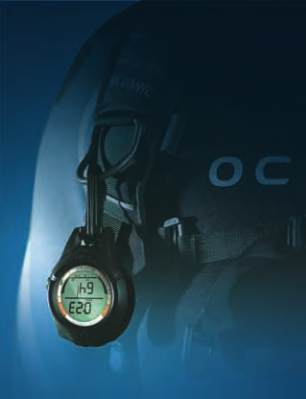
Do you dive
with a b.u.d?
Never miss
a dive.
Learn more... visit us
at OceanicWorldwide.com
for the full story.
I N N O VAT I O N F I R S T
b.u.d is a universal
backup dive computer
using Dual Algorithm
®
.
Select the Algorithm that
matches your diving style
or current dive computer...
and dive. Simple.