Basic HTML Version


www.alertdiver.com
|
15
C
onventional wisdom holds that diving mam-
mals do not suffer from decompression sickness
(DCS). This is based on two key points: First,
evolution has allowed them to adapt to the div-
ing world and, second, their gas supply is limited to a single
breath hold. As time often shows, however, experience can
be at odds with conventional wisdom.
Anecdotal reports of symptoms consistent with DCS in
extreme human breath-hold divers and substantial amounts
of physical gas found in some stranded marine mammals
raise questions about the decompression implications
of breath-hold diving. The Woods Hole Oceanographic
Institution Marine Mammal Center recently took the initia-
tive to host a workshop that brought together experts from
many fields to review the current knowledge. The panel
included specialists in human dive medicine, physiology and
decompression modeling and marine mammal medicine,
pathology, anatomy, physiology, ecology and behavior. The
meeting was held at Woods Hole in Massachusetts in April
2010. The consensus of this panel was reported in a paper
published in the Proceedings of the Royal Society – Biology.
The effects of pressure and the hazards of DCS are well
known to human divers. The increase in ambient (surround-
ing) pressure causes inert gas to flow from the compressed-
gas source into the lungs and then throughout the body. The
relative excess of inert gas flows out of the body through the
lungs during and following ascent. If the pressure reduction
is too great for a given inert gas load, bubbles may form in
tissues, and a cascade of events may be initiated that results
in symptoms of DCS. Human divers control decompression
stress by limiting the dive exposure and/or following experi-
mentally derived or mathematically derived decompression
schedules.
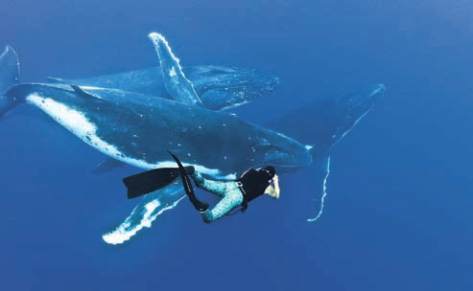
Marine mammals dive routinely and repeatedly to impres-
sive depths without the benefit of dive computers or dive
tables but also typically without obvious injury. In addition to
the limited amount of gas in a single breath, gas compression
and collapse of some small airways trap gas within portions
of the lungs to reduce the volume of gas that reaches the
blood and other tissues. These factors do not stop all deliv-
ery, though, as indicated by substantial gas volumes observed
in recently stranded animals that cannot be explained by
decomposition. In addition, necropsy studies have found
lesions consistent with chronic tissue damage as might be
expected from repetitive decompression stress. Ultimately,
these findings encourage a shift in thinking about marine
mammals and decompression.
There are several mechanisms that likely reduce the decom-
pression stress in marine mammals, even if to a lesser degree
than previously believed. The single breath of air does limit
source gas, more so for species that dive following partial
exhalation from the lungs. The collapsing airways will reduce
uptake of inert gas by the blood, at least during deeper dives.
The reduction in blood flow to nonessential tissues (part of the
diving reflex) will also reduce inert gas delivery to tissues. It
is important to appreciate that while these factors reduce the
risk, they do not eliminate it, particularly for the more extreme
divers. Ultimately, it is likely the dive profile, lung volume and
predive surface interval balance the needs of thermoregulation,
digestion, buoyancy control, hunger, predator/prey interac-
tions and exertion to determine the actual decompression
stress for a given dive or day. Voluntary and/or reflexive con-
trol over behavior and the physiological responses to diving
may alter the risk-reward balance. Extending surface intervals
or adding partial-depth dives to reduce or resolve bubble
formation may be strategies — conscious or unconscious —
that reduce decompression stress.
Future research is needed to improve our understanding
of the practical limits of the protections enjoyed by marine
mammals, the normal patterns and consequences of bubble
formation and how marine mammals and humans differ in
their response to bubbles and tissue injury. It is likely that
emerging technologies to collect real-time data from free-
ranging marine mammals will be critical to answer the many
open questions.
For now, the available evidence indicates marine mammals
manage decompression stress more than they avoid it.
— Neal W. Pollock, Ph.D.
Can Whales Get the Bends?
Decompression stress in diving mammals
S T E P H E N F R I N K
BOB CO A K L E Y