Basic HTML Version


Mighty Mouths
T E X T B Y N E D A N D A N N A D
e
L O A C H /
P H O T O S B Y N E D D
e
L O A C H
I
’ve found a real yawner of a fish,
and I couldn’t be more excited.
The magnificent gape belongs
to a lacy rhinopias (Rhinopias
aphanes), a frilly-finned, softball-sized
scorpionfish that since its discovery
by underwater photographers a few
decades ago has become a superstar of
the fish world. I see the “lacy” for the
first time on an afternoon dive after
our guide points it out, half-hidden
under a table coral at 80 feet. By the
time I arrive, two friends are already
attempting to photograph the famous
fish. But maneuver as we might, there
is no way to get a clear shot. Adding
to our frustration as we watch, the fish
blows its great mouth open so wide we
can see right down its gullet.
These “yawns” or “gapes,” as
they are known, have become
a trademark of lie-in-wait
predators such as frogfishes and
scorpionfishes. Equipped with
large mouths encased in melon-
sized heads, scorpionfishes have
taken suction feeding to extremes.
Instead of pursuing prey, the
majority of the family’s members,
including the eight species in genus
Rhinopias, have adapted to life on
the sea floor where they lie as still
as stones, masquerading as part of
the bottom. When fish swim within
range, the colossal mouths open and
shut so fast victims disappear into
the vacuum as if dispatched by a
magician’s wand.
The mechanics of the feeding
process are well documented thanks
to scientific studies that measure
speed in milliseconds, describe
mouths as “buccal cavities” and
catalog the sophisticated cranial
structure and its muscle insertions
to the last detail. But with all this, no
one knows for certain exactly why
scorpionfish yawn. Theories vary
from increasing oxygenation and
readying muscles for action, as when
a sprinter stretches before a race, to
a possible threat behavior. Whatever
the reason, the voluminous yawns are
truly impressive.
As our skiff makes it way back to
the resort off Milne Bay in Papua
New Guinea, I’m already plotting
how to capture the image. The yawn
haunts my evening and remains with
me as I switch off the reading light.
Laying awake I sort through what I
know: Some individuals yawn more
often than others; most yawns occur
shortly after a diver arrives on the
scene; if a fish yawns once, about
50 percent of the time it will yawn
a second time; and finally, yawns
are slow and deliberate like those of
bored dinner guests.
Before nodding off, I have
determined three elements critical for
success: The first, and the one I have
no control over, is finding my subject
in the open; next, quickly getting into
position so both the lens and strobe
aim directly down the throat; third, and
26
|
SPRING 2012
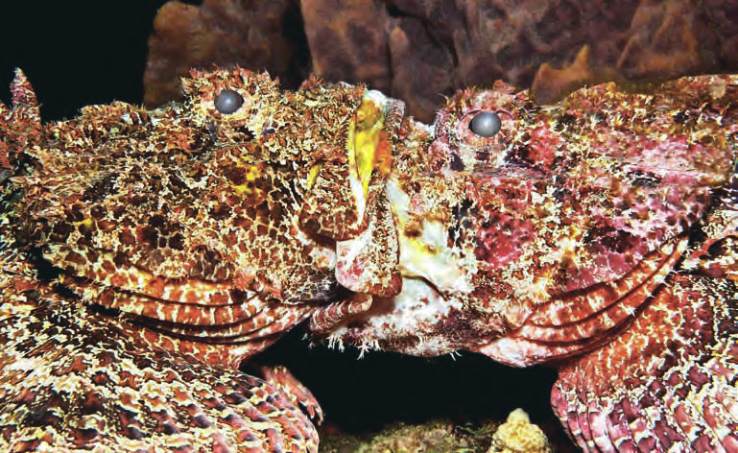
A pair of spotted scorpionfish try to figure out who has the bigger mouth.
Opposite: A yawning lacy rhinopias shows off its impressive maw.
ENCOUNTERS
GO ONLINE!
See the mighty mouths in action
at www.AlertDiver.com.