Basic HTML Version


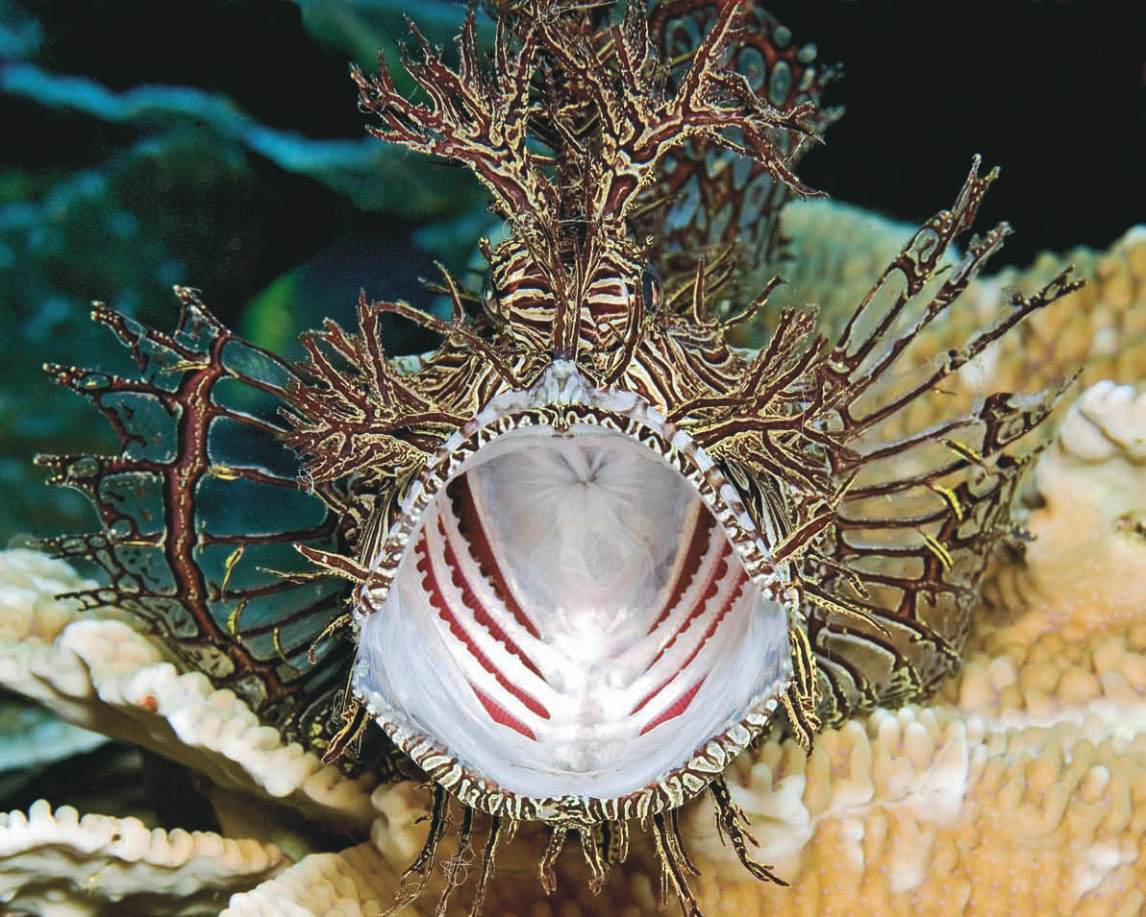
most important, waiting until the last
moment when the yawn is at its widest
and most spectacular before tripping
the shutter. I have good reason for
concern about this last point as an itchy
trigger finger, a malady known to deer
hunters as buck fever, has plagued my
photography in the past.
The next morning I join a skiff
heading back to the reef. Before
tumbling in, I take bearings from a
fallen tree marking the fish’s offshore
location. Underwater, I angle for my
mark, remaining at 20 feet while the
slope drops away. The search doesn’t
take long; from a distance I can see the
fish perched atop a coral ledge fronting
a sand chute where I can easily settle —
a perfect setup if there ever was one.
I take a deep breath and go for it,
dropping down fast and skirting the
coral ridges like a gull in flight before
alighting on the sand an arm’s length
away from my startled subject. Even
before I have a chance to steady my
camera, the fish spreads its filigreed
fins and yawns long and hard right
in my face. Taken aback, I pop off
a shot much too soon. Fortunately
there is no time to fret; the fish
begins a second yawn. “Buck fever be
damned,” I think as I bite down on
my regulator and will myself to wait
until the expanding mouth reaches
full bore.
A few months later, off the
island of Dominica in the eastern
Caribbean, my scorpionfish
adventures continue. I encounter
a pair of spotted scorpionfish,
hulking brutes the size of war clubs,
with their mouths locked fast in
what I interpret to be a territorial
dispute. Many reef fish establish
and maintain their status in a
group by directly comparing mouth
size. Mock combat might be fine
for grunts and wrasses with their
normal-sized mouths, but such
contrivances are far too genteel for
these two bruisers. Even though I
hang around for some time, neither
fish flinches nor moves so much as
a fin. In fact, when I finally leave,
the pair remains welded together
jowl to jaw, unblinkingly transfixed,
warlike and unrelenting.
AD
www.alertdiver.com
|
27