Basic HTML Version


I
’m standing within a puffin’s glide of Cape Flattery, the
northwestern-most point of the lower 48 United States,
and I’m poised to plunge off the edge of our continent.
I take a giant stride into Washington’s scuba frontier.
The cool green greets me rather abruptly, but discomfort fades
quickly as my mind turns to the business at hand: promptly
descending to 60 feet along an invertebrate-smothered wall
while fending off playful Steller sea lions. This is
Steller Rock
,
and although one cannot always count on a whiskered welcom-
ing committee here, I’m thrilled to make their goggle-eyed
acquaintance. I watch in wonder as they torpedo about.
The site’s topography is impressive: a mix of peaks, valleys
and undercuts. White plumose anemones jut upward from
the rocky seascape. Mauve sunflower sea stars graze over
a dense mat of barnacles and bryozoans, pink hydrocorals,
lobed tunicates and orange finger sponges. I focus on the
fish, finding camouflaged red Irish lords and yellow-speckled
China rockfish. A brutish cabezon, easily a stunt double for
Jabba the Hutt, guards a mound of eggs. Fearing I intend
infanticide, he’s not budging and allows me to capture a flat-
tering mug shot from up close.
We motor on to
Tatoosh Island,
passing by the sea lion
gang unceremoniously piled atop their rock and basking in
the mid-morning fog. Seabirds cry overhead as we pull up
into the shadow of a lighthouse. On our second submersion
we find nudibranchs, strawberry anemones, crustaceans and
multiple rockfish species in a canyon filled with boulders and
kelp. It is sublime.
Mushroom Rock
is a popular site in the Strait of Juan de
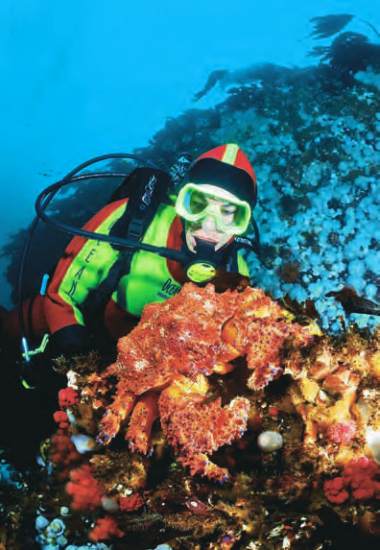
Fuca. Exploring it at 50 feet, I spot Puget Sound king crabs in
both freakishly large and cute, tiny sizes. Alien in appearance
and colorful (think Transformers dressed in tangerine and
purple spiked armor), they are prized photo subjects and easy
to shoot.
Nearby
Slant Rock
delivers super-sized rose anemones
sprouting from ledges in red and white tentacled clusters.
They prove these brisk waters, which average 45°F, are
packed with nutrients, pumping up sea creatures to epic
proportions. I’m captivated by the lovely kelp bed: The
simple elegance of bull kelp fronds waving in the sea breeze,
amber blades unfurled and streaming in the current, is
poetry in liquid motion.
You’ll never surface from these dives to find a fleet of dive
boats crowding around. Odds are you won’t encounter any
other divers at all. Out here you’re off the grid. In the shadow
of the snowcapped Olympic mountains, nestled under the
canopy of an old growth forest, you’re at the end of the road.
Diving headquarters on the Olympic Peninsula is Neah
Bay, but calling it a scuba mecca would be quite an over-
statement. This rustic fishing town sits at the end of
Highway 112 and is home to approximately 1,000 people.
It’s the center of the Makah Nation and the gateway to what
many experienced Northwest divers consider the finest div-
ing in the state. It can also be some of the most challenging.
Currents tear through the strait and scour the cape. Surge
from the heaving Pacific’s titanic swell can flip a diver upside
down. The water is cold, and visibility varies dramatically.
Fog is commonplace. There’s a potential hazard of entangle-
ment in fishing gear, and, of course, the vast emptiness of
open ocean to the west must be respected. By diving smart
and within one’s limits, however, those with proper training
and preparation will likely log these dives among their best
in the Pacific Northwest.
For those lucky enough to actually dive it,
Duncan Rock
may rank as the peninsula’s best site. The marine life is
amazing, with huge fish and thick blankets of rainbow inver-
tebrates. But this legendary spot, alone in the strait’s open-
ing, should be attempted only by those with sharp, advanced
T e x T a n d p h o T o s b y b r a n d o n c o l e
www.alertdiver.com
|
31
Washington’s
olympic
peninsula
Into the mist-cloaked Pacific
Puget Sound king crab, the Humvee
of the crustacean world