Basic HTML Version


www.alertdiver.com
|
39
I could cover a lot more ground. I also discovered the reefs
were alive with sounds I’d never heard when diving on scuba.
Aquatic creatures weren’t scared off by the noise of my
bubbles and seemed more curious than they had been before,
which made for great underwater pictures. Plus, the freedom
you feel without all the extra gear, relying solely on your
lungs for air, is unbeatable. You suddenly feel like you belong
underwater with the fish. You are not just a visitor anymore,
you are at home.
But I wondered what effect freediving would have on
my scuba diving, and I was happy to discover my good air
consumption got even better when I put tanks back on.
My comfort level in the water soared to new heights; once
you know you can comfortably dive to 100 feet on a single
breath, that same dive on scuba gear doesn’t seem quite
so deep anymore.
As for the concern about crazy people, I quickly learned
freedivers are not the lunatics I once thought they were.
Some of them freedive to push their limits and see what
humans are capable of, but most people do it for fun. Many
freedive to explore the underwater world, take pictures
and even get their dinner. Notably, most of the freediving
accidents on record happen in the latter group.
Safety firSt
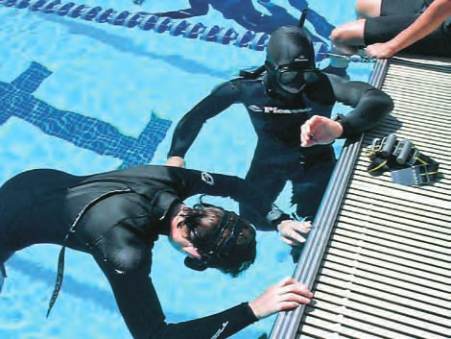
Recreational freedivers must never make the mistake of
thinking accidents won’t happen to them. Competitive
freedivers tend to pay careful attention to the safety precautions
as they generally are very aware of the potential for blackout.
Freediving isn’t about taking risks; it’s about minimizing risks to
make successful dives. Whether you freedive for recreation or
competition, the number one safety rule is always to dive under
the direct supervision of a buddy. Freediving has a very real
risk of blackout since holding your breath causes your oxygen
levels to decrease. It is just part of the sport. If you freedive long
enough you may well experience a blackout or a near-blackout.
But if your buddy is close enough to protect your airway when
that happens, he or she will be able to keep your head above
water until you resume breathing. Thus, a blackout becomes a
learning experience instead of a tragedy.
When attempting world records, athletes take safety to
the next level. At Performance Freediving International we
put at least four different safety systems in place whenever
we attempt records or host competitions. Safety is the top
priority, and we’ve developed many of the safety protocols
and systems in place today.
Quality inStruction
Anyone can grab a mask, fins and snorkel and jump in the
water, but obtaining professional training ahead of time will
not only teach you to dive with the proper safety measures
in place, it will also improve your technique and minimize
your learning curve. I have had freediving students tell me
they wish courses were available 20 years ago when they first
started because they learned more in a four-day training
program than they had in two decades of diving.
Freedive training differs from scuba training because
freediving skills require physical adaptation, whereas
scuba skills are learned motor skills. In fact, freediving,
like mountain climbing, has the unusual distinction
of requiring physiological adaptation to an external
environment. Divers lower their heart rates, shunt blood to
their cores and promote other physiological responses. The
more you freedive, the stronger these adaptations become.
There are many freediving courses available, and
content varies quite a bit. When looking for a course to
fit your needs, look for one that is comprehensive. You
should be learning a lot more than just how to hold your
breath and go underwater. Perhaps the most important
element is the safety training. There are courses being
offered around the world that have little to no emphasis
on safety, which is pretty frightening. Professional courses
prioritize the safety component. The better courses also
teach you about the physics and physiology of freediving.
A good instructor is able to explain complicated topics
in simple ways that teach you to associate feelings and
sensations with the underlying adaptations and processes.
Rather than just rattling off numbers and facts, a good
instructor helps you understand what your body is going
through and how to make it and the environment do
more for you. Class sessions can be just as engaging as
pool and ocean sessions if you find the right instructor.
Gear up
Although there is less gear involved in freediving, the gear
used is quite specific to divers’ needs. You can make do with
the gear you currently use as a scuba diver, minus the tanks,
P E R F ORMA NC E F R E E D I V I NG N T E RN A T I ON A L