Basic HTML Version


at a challenging dive (usually deep) will perform a series of
dives of increasing depth as they approach the date of the
planned deepest dive. While there is little evidence for or
against true preconditioning with this approach, there are a
number of good reasons why work-up dives may be useful,
including familiarization with equipment and sea conditions,
equipment checking in a nonchallenging environment and
refamiliarization with good diving practices.
There are ongoing efforts, particularly in Europe, to assess
the role of a number of preconditioning strategies, including
those mentioned above. Blatteau and colleagues, for example,
reported a predive sauna exposure to reduce bubble counts
following a simulated dive in human volunteers. At this
time they all remain theoretical, and I am not aware of any
practical applications that have come from this work to date.
Brubakk:
No practical applications have emerged, but data
suggest these techniques may reduce bubble formation.
AD
www.alertdiver.com
|
45
MEET THE EXPERTS
Costantino Balestra, Ph.D.,
is vice president of research and
education at DAN Europe, DAN Europe’s area director for Benelux and
France and vice president of the European Underwater and Baromedical
Society (EUBS). He also directs the Environmental, Aging and Occupational
Physiology Lab at Haute Ecole Paul-Henri Spaak in Brussels, Belgium. His
primary research interests are in the physiology of extreme environments
and sports science.
Michael Bennett, M.D., FANZCA, ANZCA Cert
DHM,
is a senior staff specialist at the Prince of Wales Hospital and
tenured associate professor of hyperbaric medicine at the University of New
South Wales in Sydney, Australia. He has 17 years of experience with the
management of remote diving injuries in the South Pacific and received his
doctorate for work on the evidence basis of diving and hyperbaric medicine.
Alf O. Brubakk, M.D.,
is professor of environmental physiology
at the Norwegian University of Science and Technology in Trondheim,
Norway. He has a background in cardiology and anesthesiology, and he
has studied decompression sickness for more than 20 years. He also
studies other areas of environmental physiology, including the effects of
cold and outer space
.
Rune Djurhuus, Ph.D.,
is a principal scientist in biochemistry
and toxicology at Norwegian Underwater Intervention in Bergen, Norway.
His research focuses on chemical contamination of divers’ breathing
gas (hyperbaric toxicology) and cellular defense mechanisms related to
endothelial damage due to decompression stress.
Please visit www.AlertDiver.com for a list of references.
Galapagos
Maldives
Silver Bank
Saba/St. Kitts
Bahamas
Turks & Caicos
1.800.322.3577
n
www.explorerventures.com
1.307.235.0683
n
info@explorerventures.com
Unique liveaboard experiences.
Exceptional value. Dive with us!
N
That’s us. Since 1987.
FAMILY-OPERATED
FAMILY-OWNED
LIVEABOARD FLEET
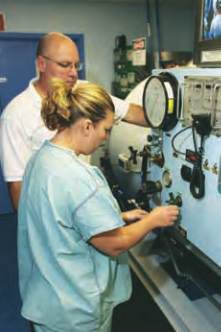
This six-day course provides comprehensive dive-
medicine training for EMTs, nurses and physicians.
DMTs act as hyperbaric-chamber operators and tenders,
field medics for divers and, in some remote areas,
physician extenders under the direction of diving
medical officers.
Topics covered include:
• Clinical applications of dive
physics and physiology
• Chamber operation
• Invasive clinical skills
• Physical exams of divers
• Evaluating medical fitness
to dive
For more information, visit
www.DAN.org/dmt
Diver Medical Technician
(DMT) Course