Basic HTML Version



www.alertdiver.com
|
47
Corrosion in cylinders usually results from water
introduced at the fill station or because there are several
drops left in the valve after its last use or rinsing. A fill whip
at 3,000 psi will atomize the drops into a vapor that coats
the interior of the cylinder. Always open the valve and blow
out the valve aperture prior to filling a cylinder (it’s best to
do this before you enter the dive center). This is especially
important if you use a DIN valve as these may hold as many
as 12 to 15 drops of water. Ask the fill station operator to
blow out the fill whip prior to attaching it to your cylinder to
prevent introducing dirt, dust or any other particulate matter.
Keeping a clean, dry dust cap on your cylinder valve at all
times except during fills and dives will also go a long way to
keeping the cylinder and valve free from contaminants.
TransporT
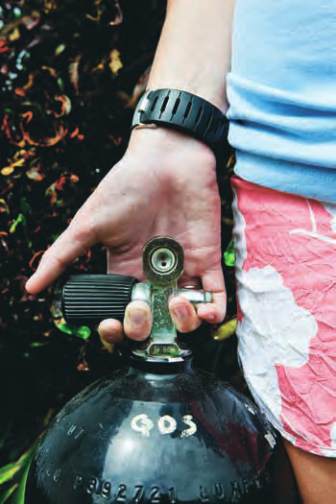
Many divers don’t put much thought into how they lift their
cylinders. If you pick it up with the orifice toward your
hand, this may open the hand wheel as you lift, blowing high
pressure gas against your skin and possibly causing skin
penetration and an air embolism. Always lift the cylinder
with the orifice away from your hand, thus closing the hand
wheel while lifting. Occasionally you may see “old salts”
stacking cylinders like cordwood, not considering that a valve
is chrome-plated brass and easily damaged. Rapid gas escape
from a damaged valve may cause a cylinder to move very
quickly and cause injury to bystanders.
It’s easy to underestimate the hazard associated with
transporting cylinders in motor vehicles, so consider that
cylinders in a vehicle move at the same speed as the vehicle.
If you have a collision, the vehicle will slow rapidly while
the unrestrained (or insufficiently restrained) cylinders may
continue to move at your original speed. An aluminum
80-cubic-foot cylinder weighs approximately 34 pounds at
rest, but at 60 miles per hour it weighs 4,091 foot-pounds.
Straps that can be used to restrain cylinders are inexpensive
and available at most hardware stores.
Care and mainTenanCe
In addition to being responsible for a cylinder’s condition,
the owner is also responsible for a cylinder’s use. Diving
is a social sport in which we often meet up with friends at
dive sites. If others show up while you are in the middle of
assembling your dive kit, don’t let their arrival distract you
— never leave a cylinder standing unattended. Always lay
cylinders down whenever they are out of reach to prevent
them from falling or being knocked over. Try, too, to keep
spare cylinders from being exposed to extreme temperatures;
for example, find some shade for them on summer days.
What constitutes proper care of cylinders? First, rinse
them with fresh water at the end of every day of diving. If
you use attachments such as pony cylinder brackets, tank
boots or twin bands, soak these in fresh water. This promotes
dissolution of any salt water trapped behind the attachments.
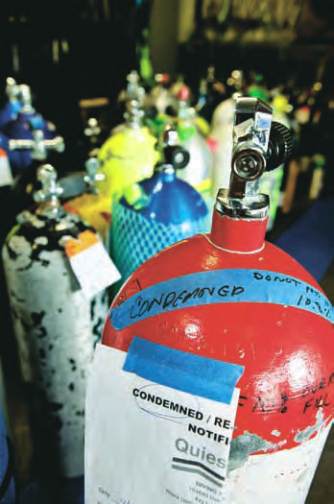
Always dry cylinders before storing them. If you store a
cylinder for a prolonged period (more than 90 days per the
CGA), reduce the pressure to the lowest you can read on the
pressure gauge. Always be sure the person who inspects your
cylinder is formally trained by a recognized agency, and use
only a reputable requalifier for hydrostatic testing.
High-pressure cylinders are a vital part of our diving
ensemble. When cared for and handled according to
established standards, they are very safe and will provide
many years of service.
AD