Basic HTML Version


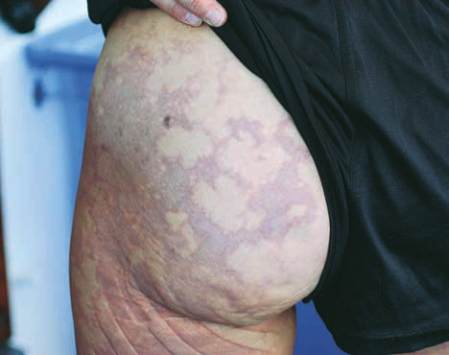
discomfort and malaise. Her companions realized she was
confused regarding their location, and she had no memory
of the morning’s dives. Her companions were alarmed and
summoned the dive staff, who placed the diver on high-flow
oxygen and arranged transport to the local hyperbaric clinic.
The evaluaTion
Upon her arrival at the clinic, the hyperbaric physician
examined her. After 20 minutes of breathing oxygen her
memory was no longer impaired, and the dizziness and
blurred vision had completely resolved. The blotchy areas
had faded, but the abdominal and breast soreness was
unchanged. The physician diagnosed her with Type II
decompression sickness (DCS) and immediately initiated
treatment in the chamber. She was treated with a U.S.
Navy Treatment Table 6 (TT6). During the treatment all
the blotchiness resolved, and the soreness in her abdomen
and breasts was greatly reduced. Besides the residual
soreness, her examination after the treatment was normal.
The physician instructed her to return to the clinic the
following morning for a follow-up exam.
The next morning her soreness was the same as it had
been after the TT6. The physician treated her again — this
time with a U.S. Navy Treatment Table 5, a shorter chamber
treatment. The soreness was further reduced, and the
physician recommended managing the residual soreness
with ibuprofen. He also strongly advised against further
diving. The soreness completely resolved over the next
two days, and the diver flew home without any return of
symptoms or other problems.
DiSCuSSion
When confronted with unfamiliar symptoms, many of
us will try to relate the complaints to something familiar
— even when the conclusion is unlikely. In this case, the
dive staff assumed the diver’s symptoms resulted from a
marine animal sting and didn’t consider or know of other
possible explanations. Skin symptoms of DCS can mimic
other conditions, but there are important aspects of “skin
bends” that help distinguish it from other dermatological
conditions. Divers may have heard skin bends described as
similar to a rash or hives, but those with the condition tend
to report dark, mottled areas that are not typically raised.
A careful evaluation including review of medical history
and dive profiles can provide further clarification. Itching,
burning or other unusual sensations may be present but
seem to occur less frequently. Deep-tissue soreness and
tenderness are the most frequently reported symptoms along
with areas that are bruised or blotchy. The surface of the
skin may or may not be tender.
The exact cause and mechanism of skin bends is not
clearly understood, and accurate predictors of individuals’
susceptibility do not yet exist. Based on the reports DAN
®
receives, the symptoms most commonly occur in areas of
the body with the most fatty (adipose) tissue. This includes
the abdomen, thighs, triceps area, buttocks and, in women,
the breasts.
According to DAN Research, approximately 20 percent
of divers who experience skin bends have accompanying
neurological symptoms. This case illustrates the
occurrence of such symptoms (confusion, visual blurring
and memory loss). The diver’s presentation was alarming,
and her companions recognized the seriousness. Any diver
who presents with potential skin bends should be placed
on oxygen and seek medical evaluation; neurological
symptoms may be subtle.
While most cases of skin bends are relatively mild,
decompression sickness is worth avoiding, and there are
some basic strategies that may help reduce the likelihood
of symptom occurrence. Using nitrox while diving air
tables (or setting your computer to “air”) will reduce the
nitrogen load (depth limits must always be observed when
using nitrox). If you’re breathing air, shorten bottom times
by five to 10 minutes and consider prolonging safety stops
beyond three minutes. Divers who experience repeated
episodes of DCS should seek a thorough evaluation by a
physician trained in dive medicine.
Early recognition of symptoms is very important. If
signs or symptoms of DCS occur, suspend all diving,
initiate oxygen therapy, and seek medical attention.
Breathing oxygen on the surface can provide remarkable
improvement, but a physician must determine whether
further treatment is necessary. Even if mild soreness
is the only symptom, further diving is extremely likely
to cause symptoms to recur or worsen. If you have any
unusual symptoms after diving, do not hesitate to call the
DAN Emergency Hotline (+1-919-684-9111) to discuss
the situation.
AD
www.alertdiver.com
|
51