Basic HTML Version


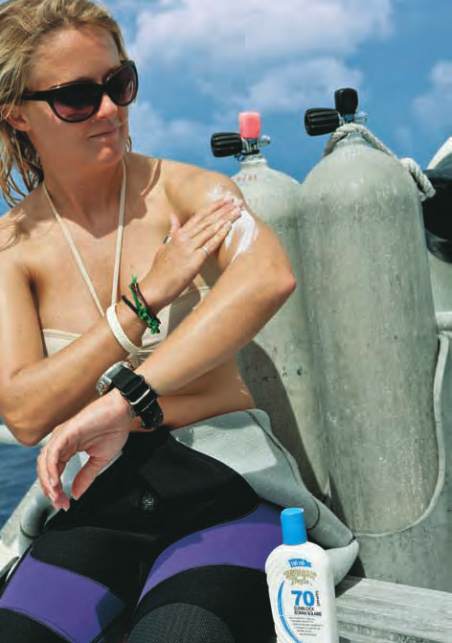
Q:
Is the sunscreen I put on before the boat
ride to the dive site harmful to the marine
environment?
A:
First of all, kudos for protecting yourself from the
sun. Sun protection is essential for skin-cancer
prevention; about 65 percent of melanomas and
90 percent of nonmelanoma skin cancers are associated
with exposure to ultraviolet (UV) radiation from the sun.
Sunscreen is a vital part of a comprehensive sun-protection
regimen that includes seeking shade, wearing a wide-
brimmed hat and UV-blocking sunglasses, covering up with
clothing and avoiding tanning booths.
Because of the vast quantity of water in the oceans,
one might not suspect sunscreen would enter the marine
environment in sufficient concentration to cause harm.
However, the World Trade Organization estimates more
than 60,000 tons of chemical sunscreen enter the ocean
every year. Sunscreen can negatively impact not only
visibility but marine life as well.
Consider that in swimming pools, professional photographers
will note a marked difference in visibility when there are few
people in the water versus many. The difference can be enough
that shooting must be postponed due to the concentration of
visibility-reducing contaminants. The sunscreen may be noticed
by smell or in the form of a small oil slick on the surface.
Although there is much water in the ocean, we usually
dive in specific, localized areas. These areas often teem with
life: coral, fish, crustaceans and a plethora of microscopic
organisms. Anything that enters the water has a tendency
to traverse the whole water column from the surface to the
bottom, coming in contact with everything in its path.
Ecologists have determined mainstream sunscreens share
in the responsibility for the deterioration of many coral
reefs. It is possible chemicals found in nonbiodegradable
sunscreens may “awaken” dormant viruses present around
corals. These viruses can replicate rapidly, killing the corals’
symbiotic algae and causing coral bleaching. Chemicals
in nonbiodegradable sunscreens can remain intact and
continue harming the environment for years. Some of the
most popular ingredients in nonbiodegradable sunscreens
are varieties of parabens, cinnamates and benzophenones,
all of which have been shown to be destructive to the
natural environment.
If you plan to lather up before diving, consider using a
biodegradable sunscreen containing a mineral ingredient
such as titanium oxide or zinc oxide. Of course, the
zinc oxide or titanium oxide may also wash into the
ocean from the wearer’s skin, but these are not known
to have adverse environmental effects. Divers might also
consider not wearing sunscreen before dives, choosing
other methods of sun protection, and then using a
biodegradable sunscreen after diving.
RESEARCH, EDUCATION & MEDICINE
//
F R O M T H E M E D I C A L L I N E
52
|
SPRING 2012
DAN Medics Answer Your
Questions about Dive Medicine
B y J o h N L e e , e M T , D M T , C h T
S T E P H E N F R I N K