Basic HTML Version



70
|
SPRING 2012
Great White SharkS
Shark diving arguably started in South Australia with diving
legends Ron and Valerie Taylor and one of the world’s most
famous shark-attack victims, Rodney Fox. After his 1963
attack, Rodney’s attitude toward sharks evolved from shark
eradicator to shark conservationist. Today the Fox Shark
Research Foundation helps fund shark research and lobbies
the Australian government to promote shark conservation.
Rodney and his son, Andrew, use the 75-foot vessel
Princess II primarily to run short liveaboard trips to North
Neptune Island, 35 miles south of Port Lincoln, South
Australia. They typically spend three to five days at the island,
where their passengers view great whites from two cages
suspended on the surface and a third cage lowered to the
bottom. I wanted to capture the majesty of great whites in the
highest resolution technically possible, IMAX 3D. I wanted
to see the audience react to this awesome predator gliding
through an IMAX 3D theater, seemingly within arm’s reach.
One particular shot I hoped to capture was a great white
shark attacking a giant stingray. Andrew had seen this happen
a few times while chaperoning shark divers to the bottom at
North Neptune, and Rodney had told me great whites killed
by fishermen are often found to have stingray barbs embedded
in their faces. These rays can be 6 feet in diameter and carry
a stinger more than 12 inches long. The battle between great
white shark and giant ray would be an epic scene in IMAX 3D,
so Peter and I spent hours on the bottom with the big camera
trained on stingrays as we waited for great whites to pass over
them. Twice we actually saw rays threaten sharks by raising
their venomous tails, but we were never close enough for a
shot, and we never saw an attack. Still, just witnessing the
interaction between these massive predators was magnificent.
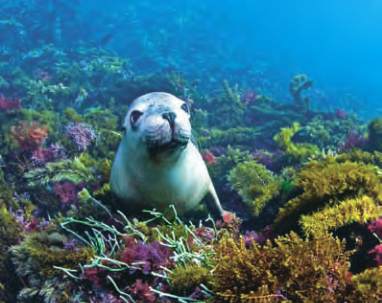
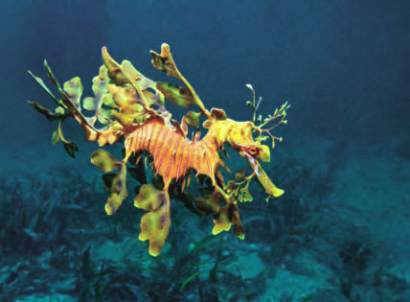
Clockwise from top: The massive IMAX 3D camera and housing require the logistical support of a sturdy boat with a crane. The leafy
sea dragons of Wool Bay are extraordinarily well camouflaged, and it takes a trained eye to discern their movement. Australian sea
lions are among the most photogenic pinnipeds, with their blond coats and gregarious demeanor. Opposite: Whyalla hosts a seasonal
aggregation of giant cuttlefish, in which thousands of these unusual cephalopods gather to mate, lay eggs and then die.