Basic HTML Version


www.alertdiver.com
|
71
But South Australia has much more to offer than great whites.
In fact, I knew the other three subjects would probably have
considerably more impact in the IMAX 3D format.
Giant Cuttlefish
After our scouting trip, Michele and I chose to run our
filming expedition in May, specifically because that is when
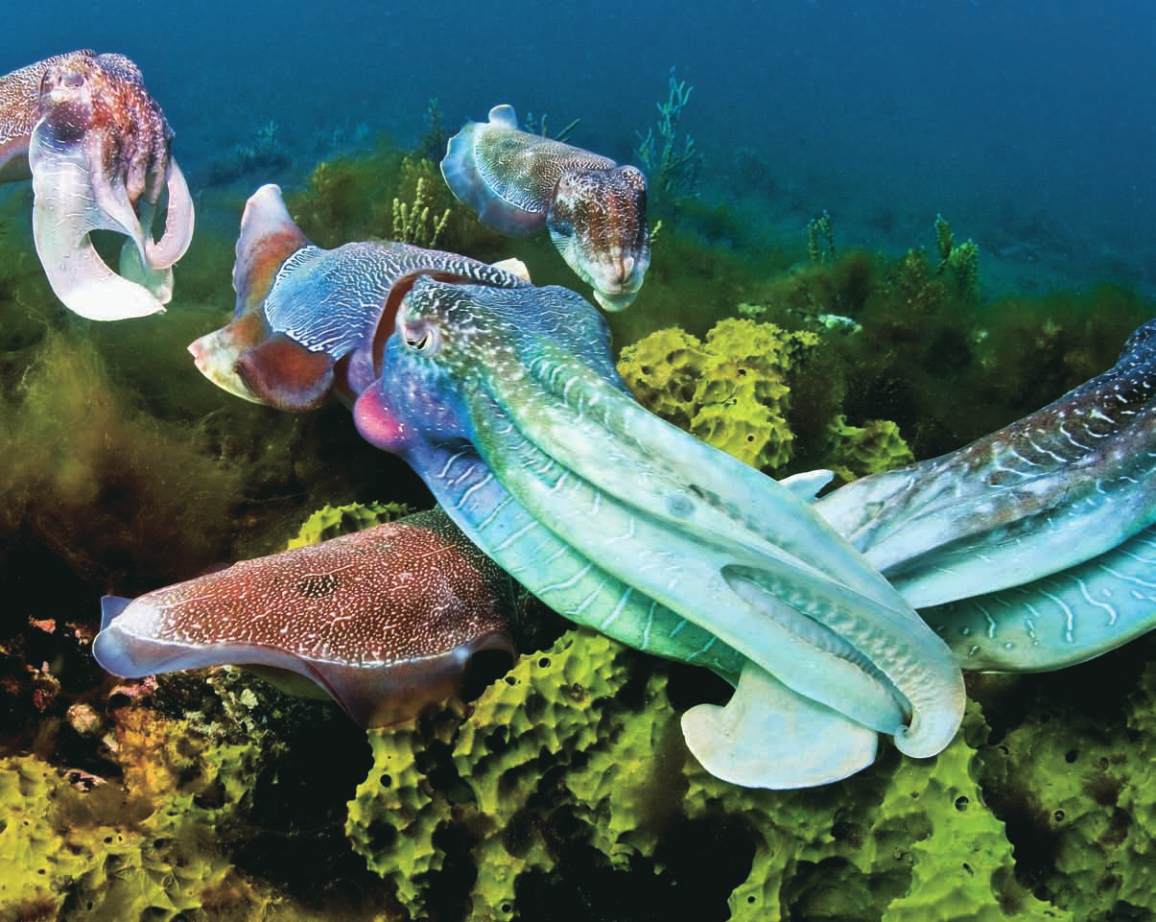
thousands of giant cuttlefish gather in the shallow waters of
the Northern Spencer Gulf to mate, lay eggs and die. These
are the world’s largest cuttlefish. Giant males reach nearly
3 feet in length.
Mark Norman, Ph.D., one of the world’s leading
cephalopod experts, guided us to Black Point near Whyalla,
South Australia. As the Princess II lowered her anchor, I was
horrified to see the chain disappear into green murk 6 feet
below the surface. The visibility was so poor we considered
turning around and heading back south. But Mark said it
could be clearer in shallow water, and despite this seeming
contrary to logic I agreed to swim toward shore to have a
look. We began seeing cuttlefish as soon as we encountered
the reef, and they were most numerous where the water
was about 12 feet deep. Amazingly, it was clearer inshore.
During the few minutes we swam around looking at the site,
visibility cleared noticeably. By late morning we had 15-foot
visibility, and by the next day we had 33 feet or more. More
significantly, giant cuttlefish were everywhere.
During the spawning season, giant cuttlefish lose all fear of
predators. They seem to know they have reached the end of
their life cycle, and their instinct for self-preservation all but
disappears. The cephalopods’ sole priority becomes mating and
laying eggs. Imminent death is inevitable. Filming the dramatic
displays of giant males competing for females is spectacular and