Basic HTML Version


72
|
SPRING 2012
incredibly easy, which is nice when trying to work gracefully in
shallow water with a camera the size of a refrigerator.
Mark explained that giant cuttlefish reproduction has an
interesting twist. Male cuttlefish live as long as two years.
The two-year-old males return to Whyalla as aggressive,
highly territorial giants. They compete for females with other
giant males and will fight with those who try to invade their
harems, producing elaborate displays of color and pattern.
But many younger, year-old males also come to the Northern
Spencer Gulf. They, too, have a successful mating strategy.
Instead of challenging the giant males for access to females,
the smaller males disguise themselves as females. These
cross-dressing males then slip past the giants and mate with
females, often unnoticed.
Leafy Sea DragonS
After spending several days filming the giant cuttlefish, we
moved the Princess II back down the Spencer Gulf and up
into Wool Bay in Gulf St. Vincent. The lush forests of algae
near the Wool Bay jetty are home to leafy sea dragons. Carey
Harmer, who has logged thousands of hours studying and
photographing sea dragons, joined us for this portion of the
expedition. We would have been helpless without him: Leafy
sea dragons are so well camouflaged you can literally stare
at one from inches away and not see it. Carey’s trained eye
was indispensable. Still, the sea dragon’s amazing camouflage
caused me considerable frustration and cost IMAX
Corporation and Warner Bros. many thousands of dollars
in film.
One of the most important shots I intended to capture for
our film was a slow tracking shot that moved through the
kelp to reveal a sea dragon. I felt this would be a spectacular
way to demonstrate the animal’s amazing camouflage. Carey
would show me a sea dragon (I was hopeless at finding them
myself), and then I would back off 20 feet, take the massive
IMAX 3D camera from Peter and begin to move it toward
the creature. I did my best to fix the location of the dragon
in the kelp 20 feet away, but at that distance I couldn’t
actually see it. Once I began to move forward, I would
switch the camera on and creep in to reveal the dragon. The
problem was that I repeatedly failed to find the dragon in the
viewfinder when I moved close enough to reveal it. Heck, I
couldn’t see the dragon when not looking through the finder.
Running a pair of 1,000-foot, 70mm rolls of film through the
camera at a cost of nearly $60 per second, I botched shot
after shot. Finally, after spending a truckload of Warner Bros.
money, I ended my 10th attempt with the dragon suddenly
materializing in the viewfinder. It turned out to be one of the
most amazing shots in the film. In the theater the kelp drifts
past the audience, and then a red dot appears to hover within
arm’s reach of the viewer, surrounded by golden fronds of
algae. Suddenly it becomes apparent that the dot is the red
eye of a creature so well camouflaged it is all but invisible.
The shot became the climax of our film.
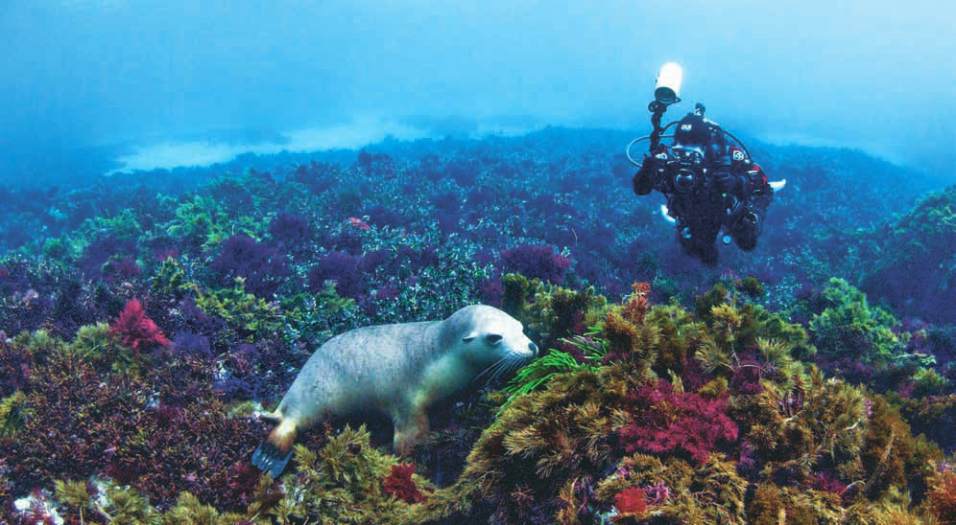
auStraLian Sea LionS
We made a third stop at Hopkins Island before moving
south to film great white sharks. In the shallow kelp gardens
of Hopkins Island, we found the charismatic Australian sea
lion. These may be the most beautiful sea lions in the world.
Unlike the dark brown California sea lions that seem to
soak up light like a cosmic black hole, Australian sea lions
are blond and beautifully reflective. Their light color makes
them much easier to capture on film than their darker
cousins. But even more important is their rather temperate
character. They like to settle on the bottom nestled within
their kaleidoscopic algae garden and just stare at the camera.
This was especially endearing when we were filming the
The Australian
sea lion is often
skittish above
water but is very
approachable
underwater,
demonstrating
playful curiosity
and allowing
intimate
interaction.
Opposite: South
Australia is
where great white
shark encounters
first captured
the attention
of recreational
divers, and it
remains one of
the best places in
the world to view
these iconic apex
predators.
HOWA RD H A L L / HOWA RDH A L L . COM