Basic HTML Version


www.alertdiver.com
|
73
animals with the IMAX 3D rig. The sea lions loved to look
at their reflections in the large, flat housing port. Many
times this left them at a perfect distance for capturing their
images in 3D (about 3 feet). But often they would plaster
their noses against their reflection in the Plexiglas, leaving
their image hopelessly out of focus. If Peter or I shooed them
away, they would immediately return to entertain themselves
by chewing on our video monitor cables or pulling on our
rebreather hoses. A short distance away, Michele captured
the action with her still camera — when sea lions weren’t
trying to swim off with her strobe. These are wonderful
problems to have after a lifetime struggling to get close
enough to capture images of wild creatures.
Andrew and Rodney like to take people to Hopkins Island
to swim with the sea lions on the first day of great white
shark trips before he takes them to see the sharks. Rodney
says that after seeing the giant predators (which often make
meals of Australian sea lions), divers are sometimes less
enthusiastic about swimming in open water surrounded by
white-shark cuisine, however beautiful the sea lions may be.
It may seem surprising, but in IMAX 3D, sea dragons, giant
cuttlefish and even Australian sea lions make better subjects
than great whites. What really works in the giant-screen, 3D
format are subjects that hover for extended periods, seemingly
within arm’s reach of the viewer. For the IMAX 3D camera,
that ideal focus distance is between 3 and 3.5 feet away. Great
whites will come close, but they don’t stay in this magical zone
long enough to produce a really satisfying 3D experience. But
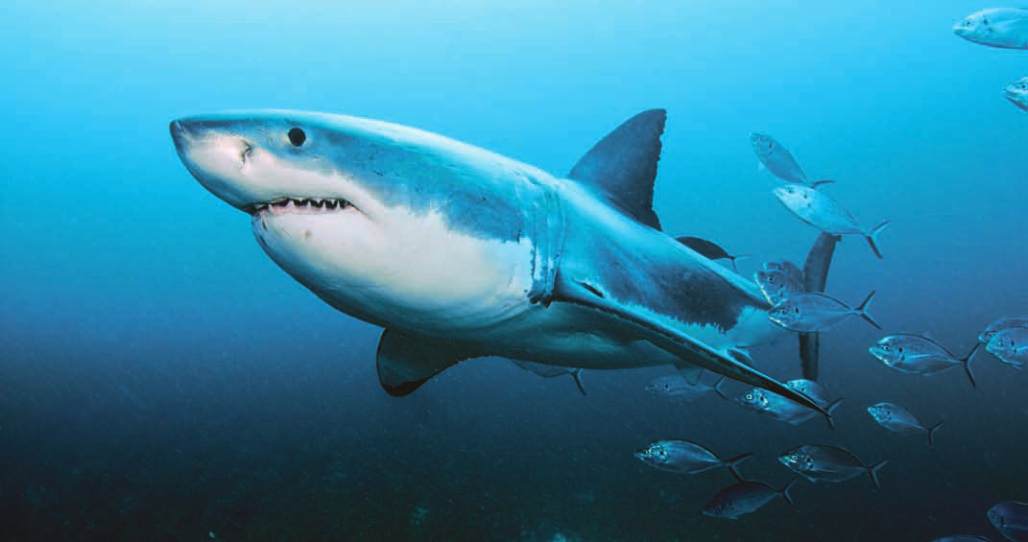
what underwater film is complete without at least one shark
encounter? What trip to South Australia would be complete
without interacting with this iconic apex predator? Besides the
obvious photo opportunities great whites present, the time
we spent with them was probably the most fun we had while
making our film.
Peter dropped the bailout regulator and pushed himself up
through the door at the top of the cage. He also looked up at
the five great whites and 50 feet of water separating us from
the swim step on the stern of the Princess II. We both realized
it would be a very long swim, exacerbated by the fact that
none of us were wearing fins. The thought of sculling our way
up through the sharks gave me a short dyspeptic sensation in
the pit of my stomach. Fortunately, there were two bailout
tanks in the cage and enough gas to last all three of us at least
another hour. However superior Rodney might think our air-
consumption skills, he wouldn’t leave us down there for more
than two hours. But I didn’t think it was going to come to that.
The blue signal rope was tied to the top of the cage. I pulled
out my knife and cut it free. Then Jeff kept watch as Peter and I
passed the rope back and forth between us, unwrapping it from
around the support cable. We each had to slip back down to the
bottom of the cage for a few drags from the bailout gas or when
a shark passed uncomfortably close, but soon the line was free
and Rodney could feel three tugs on the line (and a few more
for good measure). We made it back to the surface with a good
story to tell and easily in time for lunch.
A year after our scouting trip and our little misadventure
in the shark cage, Michele, Peter, Jeff and I, along with the
rest of our film crew, returned to South Australia with the
big IMAX 3D camera and enjoyed an enormously successful
shoot. Diving with the sharks and other animals of South
Australia was so much fun that two years after Under the Sea
3D was released, Michele and I, along with a group of good
friends, chartered the Princess II for another three-week trip
to retrace the path of our film expedition — this just for fun
and our own private image libraries. South Australia is one of
those special places of great adventure that always beckons
my return.
AD