Basic HTML Version


for them to handle on open-circuit equipment spiral out of
control when they use rebreathers simply because they do
not yet have a comparable level of experience on the newer
gear. Essentially, they push their diving too far too soon.
The role of complacency must also be considered. When
people become more comfortable in the water, they may
be more likely to bend the rules. This might manifest in
equipment preparation, such as not performing required
predive checks; dive environments, such as entering caves
before truly ready; or dive practices like diving alone. Any
of these or many other careless behaviors might lead to a
fatality while using a rebreather.
If this is so, why do people use them? For me, there are
two primary reasons: time and animals.
Benefits
I learned to scuba dive because I wanted to explore underwater.
Using air, my dive times were constrained primarily by nitrogen
loading. I couldn’t stay too long, as no-decompression limits
restricted time at depth. Even when I began exceeding those
limits, venturing into the realm of decompression diving, I still
could not stay as long as I wished.
Nitrox eased those time constraints a bit, but it was still
fairly restrictive. I had to match the gas I planned to use with
the depth of the dive. If my dive plans changed (with regard
to depth) it was very difficult to change the gas mix to suit —
each change meant a trip to the dive shop to empty and refill
a cylinder, which was impractical.
A rebreather is essentially a self-contained nitrox-mixing
machine. It is able to provide the optimal nitrox mix for
your depth, changing the oxygen content as you move up
and down in the water column. By doing this it is possible
to double, triple or even quadruple your no-stop dive times
compared to air.
And you can do this while carrying only 40 cubic feet of
breathing gas, half diluent (air or nitrox) and half oxygen.
Because you are not wasting gas by expelling it into the
environment, 20 cubic feet of oxygen can last as many as 10
hours underwater, regardless of depth. Just think, a 20-cubic-
foot pony bottle could provide enough gas to stay at 100
feet all day, without refills and without going to the surface.
This does not account for decompression considerations,
of course, but the gas volume could last. For me, that was a
magnetic attraction.
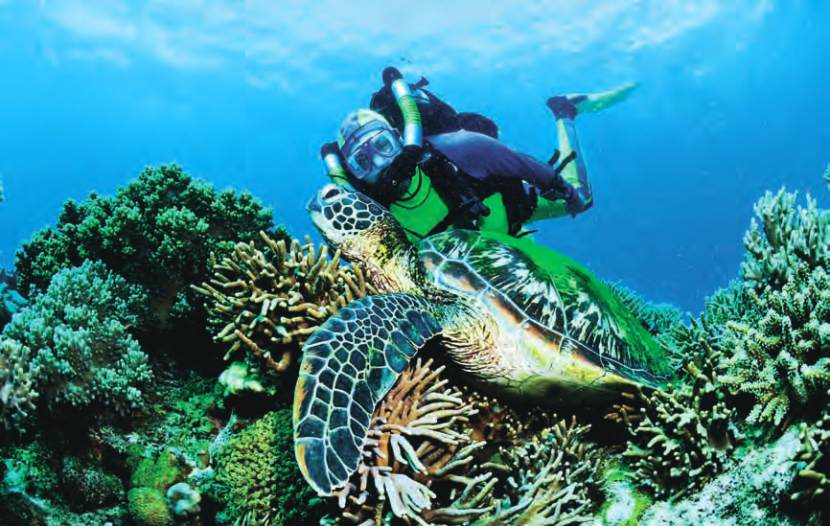
Another advantage to no bubbles is the possibility of
improved interaction with wildlife. We look at fish in
different ways: Snorkeling, freediving, open-circuit scuba,
surface-supplied hookahs and rebreathers are all just tools
that allow us different ways to see the underwater world. I
see more fish when I dive with a rebreather, but to me the
quality of fish is more important than the number I see.
Using a rebreather, I see rare fish more frequently. I see
more unusual behaviors and fish acting more naturally. The
most fun is seeing animals I have never seen while using a
scuba tank: dolphins, whales, tuna, wahoo and other species
that shy away from the noise bubbles generate. As a result,
rebreathers have vastly expanded the variety of species I’ve
been able to capture in underwater photographs.
Other advantages
In warm-water locations like Palau, the Bahamas and the
Caymans, water temperature is never the reason I have to
surface; it’s always nitrogen loading that limits my dive time.
When I travel with a rebreather and dive with groups of
divers using a variety of equipment, I typically get to spend
about twice the amount of time underwater as the open-
circuit divers. The rebreather can even be set so I can do my
“surface interval” while I am still at depth, shooting pictures
while the others sit on the boat or beach waiting to reenter
the water. As long as the dive operator is comfortable with
82
|
spring 2012
cour t e s y J e f f Bo z a n i c
Many divers
choose
rebreathers
because fewer
bubbles may
mean improved
interaction with
wildlife.