Basic HTML Version



Recently I had a 12-hour layover in Guam.
Rather than sit in the airport, I had a friend
pick me up for a quick and very shallow
dive at Fisheye Beach. I was using a semi-
closed rebreather configured with a very
rich oxygen mix to allow me to fly just a
few hours after exiting the water.
My friend brought all the gear I needed
for the dive, including the rebreather.
Because we were on a tight schedule, I
did not check the rebreather myself — I
assumed it had been properly assembled.
We arrived at the beach, quickly donned
our gear and waded into the water.
I was enjoying the dive. It was warm,
calm and only 20 feet deep. I noticed it was
getting a little harder to breathe but didn’t
think anything of it. After about 30 minutes,
I stood on my head while submerged to look
under a coral ledge. I heard a “pop.”
My next inhalation was very difficult, and
on the one that followed I got a mouthful of
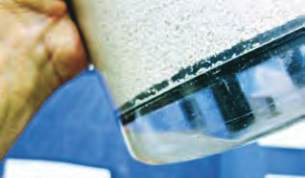
liquid — a very caustic liquid. My mouth,
lips and throat all felt like they were on fire.
The material that removes CO
2
from
divers’ exhalations is a strong alkali.
When it mixes with water it forms a
solution similar to those commonly used
to clear clogged sinks and shower drains.
It is capable of causing severe chemical
burns, as I was experiencing firsthand.
Immediately, I closed the mouthpiece
and spat it out. My mouth was still burning
badly — very badly. I began rinsing my
mouth with salt water while I grabbed the
second-stage from my emergency open-
circuit bailout bottle to breathe. That was
when I discovered I could not inhale. My
throat had spasmed, making it impossible
for me to take a breath.
I signaled my buddy and started to
ascend. As shallow as dive the dive was,
it should have been an easy emergency
swimming ascent. But as I began to go
up, I realized I could not exhale either.
Ascent would mean an embolism — not
good. Next, I began retching involuntarily.
My buddy had joined me and began
trying to shove his backup regulator into
my mouth. He thought I needed air, not
realizing I had already tried that. I kept
shoving his hand away, attempting to
communicate the real problem. I settled
back to the bottom and continued to flush
the burning liquid from my mouth.
Finally, after holding my breath for one
to two minutes (an eternity, it seemed)
the spasm eased, and I could breathe
again. Upon reaching the beach and
crawling out of the water, I immediately
began continuously and violently retching
onto the sand. My throat was burned, and
it was painful and difficult to breathe. I
could not swallow at all.
This situation could easily have been
prevented had I taken a few minutes
before the dive to check the rebreather.
A simple negative pressure test — one I
teach all my students to do — would have
revealed that one of the hose connectors
was improperly secured. It had probably
been slowly leaking the entire dive. When
I turned upside down, the fitting popped
out, allowing seawater to flood the
system. Caustic cocktail was the result.
I could not eat for three days, and
it was several weeks before I felt like I
was back to normal, but I had learned a
valuable lesson. No matter how rushed
you are, predive safety checks are a vital
part of rebreather diving.
the protocol, I love doing that.
Because rebreathers can be set to provide a high-
percentage oxygen mix, they can be used at shallow depths
without incurring any inert-gas (e.g., nitrogen) loading at all.
No nitrogen loading means no decompression-sickness risk
and no mandatory delay to fly after diving. This has allowed
me and other rebreather divers to add an entire extra day’s
diving at some travel destinations.
Gas efficiency is a great benefit to technical divers because
it gives them far more time to pursue their objectives while
underwater. Additionally, because many rebreather units may
also be used with helium-based breathing gases such as heliox
or trimix, they are particularly well suited for deep-diving
applications. A technical dive that might cost an open-circuit
diver $200 in gas might cost a rebreather diver only $15 to $20.
However, the initial investment for rebreathers is relatively
high. A typical unit might cost two to six times that of an
open-circuit system. In general, training is also more expensive
than traditional scuba. Cost of both training and equipment
has been decreasing over the years, but it will be some time
before there is parity between the two modes of diving.
Is a rebreather the right tool for you? Only you can answer
that. Rebreathers do not necessarily require a lot of dive
experience, but they do require special training, and their use
does demand great attention to detail and a willingness to
spend a little more time on care and maintenance. They may
be costly to own and operate, but they have the potential to
allow you to do and see more.
If the benefits a rebreather provides appeal to you, you
might wish to consider using one. If not, stick to the tools
you know. Either way, I wish you continued enjoyment and
safety in your underwater explorations.
AD
By Jeffrey Bozanic
What I Learned about dIvIng from a CaustIC CoCktaIL
www.alertdiver.com
|
83
J e f f Bo z a n i c
chr i s t i a n c l a r k