This is a SEO version of AlertDiver_Summer2011_web. Click here to view full version
« Previous Page Table of Contents Next Page »FROM THE SAFETY STOP // P U B L I S H E R ’ S N O T E
I
n early June I got a call from my photo agent in London to ask if I could cover a group of wounded veterans of the wars in Iraq and Afghanistan as they underwent scuba diving instruction and, eventually, a few open-ocean dives. The client was the Sunday Times Magazine, and, to my great pleasure, the group was Deptherapy.
I had done a brief photo session with Deptherapy maybe a dozen years ago, when Spencer Slate of Atlantis Dive Center in Key Largo, Fla., asked me to take some photos of disabled divers getting pool instruction, and it was then I met Fraser Bathgate, director of the program. Bathgate is a paraplegic as a result of a wall-climbing accident when he was just 23 while training for an expedition to the Himalayas. At that time our meeting was pretty superficial; I was busy shooting photos, and Bathgate was occupied looking after his students. But this time it was different. I had more time to immerse myself in their world and consequently was able to learn a lot more about the rehabilitative effects of scuba diving.
The first thing I noticed was the camaraderie between this group of British and American veterans. Theirs was a bond forged from the common experience of military service and grave injury sustained in the course of that service. The other thing that immediately impressed me was the level of community sup-port given to this group. As a child of the ’60s, I clearly remember the disrespect and disdain my buddies endured when they came home from service in Vietnam — those who came home at all. Gratefully, those who serve their country today seem to be treated with more reverence, and certainly the community in Key Largo was visibly honored by their presence.
To be a Deptherapy instructor one has to take the Disabled Divers International (DDI) instructor program to learn to better accom-modate the physical and psychological needs of physically disabled divers. Apparently, even
a slight skin abrasion sustained in the pool may lead to infec-tions in an amputated limb that could significantly delay the healing process. From the pool sessions onward a different skill set and awareness is required of staff. This particular pool session included introduction to the Pegasus Thruster,
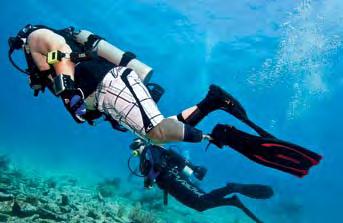
a small, powered propeller that mounts to the back of a scuba tank and is manipulated by a corded, handheld con-troller. For the physically impaired it is a marvelous asset. The payoff came the next day in the ocean. Capt. Slate took the group to the City of Washington, an offshore ship-wreck that is home to his weekly critter feed. Nurse sharks and a semifriendly green moray, long acclimated to Slate’s unique form of classical conditioning, swam amid the group of soldiers, allowing intimate interaction. The most moving moment for me came when swimming along the deck of this shallow wreck; I was able to get a photo of Jeremy Stengel diving with buddy Drew Richardson (president of PADI) in the background. Stengel had his Pegasus Thruster cranking at full bore and his specially fitted prosthetic fins engaged to leave me in his wake. He’d wait for me to catch up, compose my shot and then quickly outdistance me once again. I think this little game amused him mightily. I know it did me.
This reminded me how therapeutic scuba diving can be in general. I know for me the stresses and distractions of daily life slip away when I get in the water, as they did in May when I had a chance to dive with oceanic whitetip sharks off Cat Island in the Bahamas.
Scuba Therapy
B Y S T E P H E N F R I N k
8 | SUMMER 2011
Jeremy Stengel (foreground) and Drew Richardson dive the wreck of the City of Washington.
This is a SEO version of AlertDiver_Summer2011_web. Click here to view full version
« Previous Page Table of Contents Next Page »