This is a SEO version of AlertDiver_Summer2011_web. Click here to view full version
« Previous Page Table of Contents Next Page »Hometown: Key Largo, Fla.
Age: 50 Years Diving: 31
Favorite Dive Destination: Aquarius underwater laboratory

Why I’m a DAN Member: “To lend my support to DAN’s mission of providing medical emergency assistance.”
20 | Summer 2011
DIVE SLATE //
F
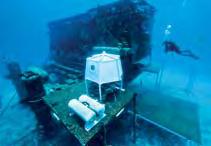
or the sheer quantity of marine life it supports and the colorful background of sponges and corals that have grown on its metal surfaces in 18 years, the Aquarius Reef Base underwater laboratory has become a lush, vibrant and unique dive site, and one of the most unusual in the Florida Keys. Of course, the “habitat” (as locals call it) requires special permission to dive and is typically inaccessible when science missions are in progress, but in a place world-renowned for its recreational dive opportunities, it is notable that such sophisticated infrastructure for oceanic research likewise exists. Integral to the successful operations of Aquarius is its associate operations director, Otto Rutten. A member of the team since 1994, Rutten has worn a number of hats and traveled a circuitous road to arrive at Aquarius. Like so many, he watched Jacques Cousteau on television as a teenager and dreamed of a career in marine biology. And yet his dream was even more specific: He wanted to be a marine biologist in the Florida Keys. Even with the optimism of youth, he knew it was a long shot. As a college student at North Carolina State University, Rutten showed an aptitude for engineering, but his overriding passion remained marine biology. He felt his greatest strength was in supporting marine science rather than conducting it, and he went to work for the North Carolina Division of Marine Fisheries (NCDMF) and simultaneously embarked on a master’s program at the University of North
Carolina at Wilmington (UNCW). UNCW hosted one of six National Undersea Research Centers, each of which were sponsored by the National Oceanic and Atmospheric Administration (NOAA) and offered different areas of study. At UNCW the focuses were remotely operated vehicle (ROV) technologies, nitrox (at a time when nitrox was experimental in nature), and hardhat and mixed-gas diving. These areas of study were relevant to Rutten in his work surveying the deep ledges off North Carolina for NCDMF, and the new nitrox technology made his job safer. At that time the Aquarius lab was located off Salt River Canyon in St. Croix, U.S. Virgin Islands, but Hurricane Hugo hit that area hard in 1989. One of the most powerful storms ever to strike the Caribbean, Hugo damaged the habitat and made it necessary to transport it back to Wilmington for repairs. As the team considered where it might be better deployed in the future, Key Largo came to mind for its easy access and highly developed coral reef. Rutten was still a student at UNCW then and traveled to Key Largo for the lab’s installation in 1992. By the time scientific missions ramped up in 1993, he was immersed in mission support, to the extent that when an assistant science director was needed, his science background and captain’s license made him the perfect candidate. By April 1994 his dream of living in the Florida Keys and doing marine science was fulfilled.
From there, one thing led to another. After three years as the assistant
science director he became the science coordinator, overseeing the day boat program and operating what was essentially a dive shop for scientists. That job eventually morphed into his current position, associate operations director. To better understand what Rutten’s job entails, it is necessary to understand the Aquarius underwater laboratory. Aquarius is an 82-ton double-lock pressure vessel nearly 50 feet long and 13 feet wide. It’s owned by NOAA and managed by the National Undersea Research Center, and it operates 60 feet below the surface about 3.5 miles offshore of Key Largo. The lab’s principal function is to provide the technology of saturation diving to science, allowing far better time efficiency than no-decompression diving to the 60-foot depths and beyond that surround the habitat. When you consider that most research scientists must conduct their studies in between teaching obligations, the need for such time economy is readily apparent. As a platform from which aquanauts explore a weightless environment alien to human habitation, the lab is also used by NASA for underwater astronaut training. The living quarters under the ocean are reasonably comfortable, and the research capabilities are sophisticated. Satellite communications allow crews to stay in touch with the outside world. Aquarius has a shore-based mission control center with a watch desk incorporating computers and communication gear linked to Aquarius via wireless telemetry. A life-support buoy floats on the surface above the
OTTO RUTTEN
Living His Dreams
MEMBER PROFILE
T e x t a n d P h o t o s b y S t e p h e n F r i n k
This is a SEO version of AlertDiver_Summer2011_web. Click here to view full version
« Previous Page Table of Contents Next Page »