This is a SEO version of AlertDiver_Summer2011_web. Click here to view full version
« Previous Page Table of Contents Next Page »O
n Monday, June 21, 2010, I nearly drowned on the back deck of a dive boat 30 miles off Morehead City, N.C. The day started with a 5:30 a.m. wake-up from an all-too-short night. My teenage son, Noah, and I had arrived in Morehead City the previous evening after a late getaway from Richmond, Va. This was his first offshore trip. The ride out to the dive site was a little choppy but uneventful. Any day the sea cooperates is probably a pretty good day for diving off the North Carolina coast. The
water was a warmish 76°F at the bottom, and the visibility was about 50 feet. We were exploring the wreck of the U-352, a German submarine that was depth-charged by a U.S. Coast Guard cutter during World War II and now lies at a depth of about 110 feet. Exactly one year prior to this dive I had saved a diver who ran out of air on this wreck.
It was just before noon when we began to ascend from our second dive. At 50 feet I coughed for the first time. It was a normal, tickle cough from dry air, except, unusually, there was a gurgle of liquid deep in my throat. By 30 feet I was coughing continuously. With each cough, more liquid rose in my throat. It tasted metallic, not quite like blood but not like saliva either. When we transferred to the safety line at 18 feet, I began to hyperventilate. I was now actively swallowing the fluids I was coughing up, and the urge to rip the regulator out of my mouth was almost overwhelming. Despite efforts to calm down and slow my breathing, I sucked on my regulator desperately, taking increasingly rapid, shallow breaths. I had no doubt that I was over-breathing the regulator but could not understand why. Bad air? Probably not; I had dived with gas from the same source in the morning. Pulmonary embolism? Doubtful; I had not made any rapid ascents and was well within my no-decompression limit.
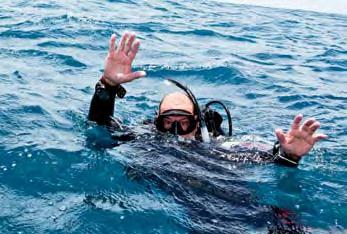
It quickly became clear that I’d either have to surface or black out, so I grabbed Noah to buddy him up with somebody else. I put his hand in the other diver’s, looked into his eyes and headed up. Leaving was almost as difficult as breathing. Reaching the stern of the boat 30 seconds later, I signaled distress and was promptly hauled bodily out of the water by the crew. To be perfectly honest, I expected to cough up whatever was in my throat. I thought I’d be fine now that I had reached the boat. I was wrong, and it was the most disappointing and terrifying realization of my life. As I was hauled onto the swim step of the Diver Down, I gasped for air, croaking “Can’t breathe! Can’t … breathe!” Behind me, Noah was emerging from the water, safe but shocked as the crew raced to prepare oxygen and move me inboard. My skin was pale, and my lips and fingernails were blue. With each failed breath it became clearer to me that this was where I was going to die, cold and wet on the back of a dive boat — not at all what I had expected.
Just then, luck intervened. My friend Sharky, an EMT with dive-medicine training, was already back onboard. He took my vitals and placed an oxygen mask over my face. Listening to my lungs, he could hear the crackle of liquid as I struggled for air. He relayed the grim news to the captain
30 | Summer 2011
RESEARCH, EDUCATION & MEDICINE // D A N WA S T H E R E F O R M E
Drowning from the Inside Out
A rare complication makes for a harrowing day.
B y P h i l W a l k e r
This is a SEO version of AlertDiver_Summer2011_web. Click here to view full version
« Previous Page Table of Contents Next Page »