This is a SEO version of AlertDiver_Summer2011_web. Click here to view full version
« Previous Page Table of Contents Next Page »decision was made to race in. One of the great things about the Diver Down is its speed. It can do 21 knots at a push, making it perfect for reaching rarely dived wrecks far offshore. That day, it was to be my ambulance. My buddies took turns trying to keep me warm, all while making entirely inappropriate jokes about splitting up my dive gear, taking my money and so on. It was hard to breathe, but it was also hard not to laugh. As we got under way, Noah took his turn sticking with me to keep me present. Throughout the one-and-a-half-hour trip, he kneeled behind me, supporting my back. Swell from the bow sprayed over us as the vessel hammered through the waves. Each time Noah would hunch over me protectively. The guys took turns taking vitals and making sure I was awake and breathing.
Ten minutes after making landfall, we were in the emergency department at Carteret General Hospital. From there I was transferred to the critical-care unit as they worked to keep up my oxygen levels.
Twenty-four hours and a lot of oxygen later, I walked out under my own steam to the applause of the unit’s nursing staff — apparently such dramatic recoveries after such serious symptoms didn’t happen there often. Thanks to the quick actions of the crew, my son, my friends and the experts at DAN ® , I had survived. It was a really good day. The obvious question is, “What happened?” To put it simply, I drowned from the inside out. Th e DAN medical team pegged my condition as immersion pulmonary edema (IPE), also known as swimming-induced pulmonary edema. IPE is an accumulation of fluid in the lungs while in the water. Unlike drowning, IPE does not involve the aspiration of water through the mouth. Instead, a spike in blood pressure in the pulmonary vessels causes blood and serum to leak into the alveolar spaces in the lungs. The reason for the spike, particularly in otherwise healthy individuals, is not entirely clear. However, research at the Duke Center for Hyperbaric Medicine and Environmental
Physiology under Dr. Richard Moon is helping to improve our understanding of the phenomenon and its causes. After extensive testing, the assessment was that I am one of the unlucky 1 percent or so of divers prone to this condition. To return to diving, I have been advised to lose some weight and lower my blood pressure, get recertified with my drysuit and start diving dry for anything colder than tropical dives. The doctor also recommended that I avoid excessive hydration prior to diving and consider taking anti-hypertensive medicine before I dive. (Editor’s note: Always defer to your personal physician for medical advice.) After careful consideration, I ultimately made the decision to retire from offshore wreck diving, decompression diving and any dives deeper than 100 feet. The logic is simple: It appears likely that despite my best efforts, I might experience IPE again while diving. If it occurs at depth, I will use up all my air in a heartbeat. I am fortunate to have a wonderful family whom I love and who need me. I also have an incredible dive family who would do everything within their power to save me. I cannot responsibly ask either family to bear this risk, so instead I will enjoy the wonders, colors and warmth near the surface and look for other ways to engage my passion for the depths.
Every incident has its causes. The bottom line is that a gap in my fitness level combined with unfortunate genetics seems to have caused this one. Like many of us, I’ve picked up some pounds over the years, and this has raised my blood pressure slightly. It hasn’t been a big deal on land, but it became a huge deal underwater.
I was already a huge fan of DAN, but this cemented it for me. DAN’s awareness campaigns ensured that there was a lot of oxygen onboard and that the crew was trained to administer it. Research done by DAN informed the dive-medicine training of everyone onboard the boat, and DAN’s medical staff helped ensure I got the right diagnosis and the right treatment. DAN funds supported the research I participated in, and DAN insurance paid all my out-of-pocket expenses. It is hard to imagine any other way DAN could have helped.
Here’s my takeaway: I have a resting pulse in the 40s and can ride, run or swim for hours at a stretch — in many ways I’m a pretty fit guy. But diving takes me into an environment that is inherently hazardous. Any weakness in my constitution, when combined with circumstances and genetics, can generate many different ways to die. While advances in equipment and training have made diving safer than ever, I need to keep my DAN membership and dive accident insurance up to date and bring my A-game every time. You do, too. AD
32 | SUMMER 2011
RESEARCH, EDUCATION & MEDICINE // D A N WA S T H E R E F O R M E
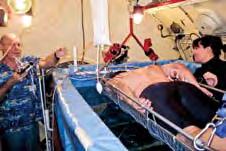
Walker undergoes testing in a hyperbaric chamber at Duke University Medical Center.
This is a SEO version of AlertDiver_Summer2011_web. Click here to view full version
« Previous Page Table of Contents Next Page »