This is a SEO version of AlertDiver_Summer2011_web. Click here to view full version
« Previous Page Table of Contents Next Page »www.alertdiver.com | 53
Mechanisms of Injury
Lightning causes injuries in several different ways:
• Direct strike. A stepped leader from a cloud connects with a streamer coming from a person, and a bolt of lightning comes from the sky, striking that person directly.
• Direct contact. Lightning strikes an object such as a flagpole or fence, which conducts current into an individual touching it.
• Splash or side flash. Lightning strikes a nearby object such as a tree and arcs over the victim as it seeks the ground.
• Ground current. Where lightning hits the ground, current travels out through the earth in all directions. The current diminishes over distance.
• Blast. A lightning bolt instantly heats surrounding air to temperatures between 18,000°F and 60,000°F. This sudden rise in temperature causes rapid expansion of air, resulting in a blast (and causing thunder).
Assess your Risk
It is much safer to be indoors than anywhere outdoors in a thunderstorm. To avoid being caught out in a storm, familiarize yourself with local weather patterns or listen to a forecast. In many areas, thunderstorms are most common
in the afternoon, so plan excursions early in the day. Even if there is blue sky overhead, lightning may still be a hazard if storm clouds are in the area. It is not uncommon for lightning to strike several miles away from a storm; in rare cases, “bolts from the blue” have struck the ground as far away as 10 to 15 miles from storm clouds, possibly even farther.
The high speed at which light travels means lightning is visible almost instantaneously, no matter how far away it is. Since sound travels at about five seconds per mile, it’s easy to estimate the distance to a lightning strike by counting the seconds between a flash and the associated thunder. For every five seconds you count, the storm is one mile away. It’s a good idea to take evasive action when a storm comes within six to eight miles or when the delay between a flash of lightning and its associated thunder is 30 to 40 seconds or less. In the commotion of a thunderstorm it may be impossible to determine which flash of lightning is associated with which clap of thunder, so it is safest to take precautions any time there is enough lightning and thunder to cause such confusion.
Take Cover
The safest place to seek shelter during a thunderstorm is inside a large, permanent structure. If no such building is available,
800.322.3577 • +1.307.235.0683


www.explorerventures.com • info@explorerventures.com
“Can’t wait for my next liveaboard ... definitely plan to dive with Explorer Ventures in the future.”
James G., April 2011, Northeastern Caribbean
Come join in the fun!
800.322.3577 • +1.307.235.0683
Come join in the fun!
Turks & Caicos Saba/St. Kitts Galapagos Bahamas Maldives
Come play


with us!
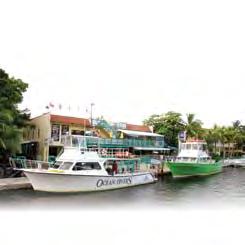
Key Largo’s
Dive Operator
since 1975
OceanDivers1-4PgFINAL.indd 1 9/28/10 8:58 AM
This is a SEO version of AlertDiver_Summer2011_web. Click here to view full version
« Previous Page Table of Contents Next Page »