This is a SEO version of AlertDiver_Summer2011_web. Click here to view full version
« Previous Page Table of Contents Next Page »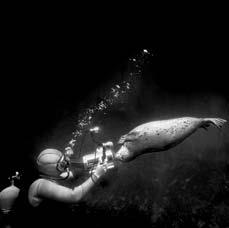
17, and Chuck Davis, Cathy Church and Jim Church were enrolled there as well. Al Giddings, Bob Hollis, LeRoy French, Bill DeCourt, Chuck Peterson, Ron Church and others would meet at Brooks Institute and formed the Academy of Underwater Photographers, creating exhibits, seminars and products for the nascent underwater photography industry. Ron and Valerie Taylor spent many days in the water working on Brooks projects with students; Jean-Michel Cousteau and Philippe Cousteau would dive with us as well.
It was kind of like the early days with my father when Ansel Adams and Edward Weston lived just up the road in Carmel, Calif. They often needed darkroom assistants, and the Brooks Institute was one of the first places they went to recruit. Brooks was a nexus for the
“Group f/64” shooters back in that era. In much the same way, the world of underwater photography came in contact with the institute, most often aboard our 57-foot former purse-seine trawler, Just Love. I enjoyed the irony that a vessel that once plundered the seas in Alaska was now being used by some of the world’s most influential underwater photographers and their protégés to celebrate the sea’s beauty and bounty in photographs.
SF// I will always associate you with one camera, the Hasselblad Super Wide. How did that affiliation begin?
EB// In 1961 Victor Hasselblad came to visit Brooks Institute and lectured on medium-format photography with his Hasselblad cameras. While visiting he saw the underwater photography I was doing with an Exakta 4 rangefinder and housing, and unbelievably he gave me a Hasselblad Super Wide C with the brilliant 38mm Zeiss Biogon lens. The lens had 90-degree diagonal coverage, not so different from the Nikonos 15mm at 94 degrees; but to achieve wide-angle underwater, Hasselblad had created a housing with an Ivanoff corrective port, and he gave me one of those, too! Given the quality of the camera and the housing, and the fact that it was prefocused at 6 feet from the front glass,
that was my universe. I found and photographed things 6 feet away that fit the format of my Super Wide.
SF// You obviously are a master of the analog darkroom, but have you embraced digital as well?
EB// Yes, of course, you can’t ignore the technology. In fact, I do a lot of digital infrared black and white these days. Even my traditional analog images are now printed by digital means. Epson actually designed a paper for my “Fragile Waters” exhibit to optimize the tonalities of my black-and-white underwater images when printed with a digital inkjet. The result can be seen in a traveling show with 6,000 square feet of images now on tour to major art museums around the world.
I likewise embrace the electronic medium of the Internet; I know it is the ultimate tool for communication. My goal with my photography has been to inform and inspire people to revere and protect the ocean. If by my book and exhibitions and teaching I have done that, then I will have done my part to preserve the sea. I truly believe the best way we can impress upon the world that the sea is worth saving is by presenting the beauty within it. Only then can people grasp how important the ocean is to everything on this planet. AD
90 | SUMMER 2011
IMAGING // S H O O T E R
In one of Brooks’ most iconic images, Spot, the engaging and enigmatic harbor seal, poses for the video camera.
This is a SEO version of AlertDiver_Summer2011_web. Click here to view full version
« Previous Page Table of Contents Next Page »