DAN Medics Answer Your
Questions about Dive Medicine
B y t h e D A N M E D I C A L S T A F F
www.alertdiver.com
|
41
F R O M T H E M E D I C A L L I N E
\ \
RESEARCH, EDUCATION & MEDICINE
Q:
When administering first aid oxygen to an
injured diver, is there a risk of oxygen toxicity?
I’ve heard about “air breaks” — are those
necessary when providing first aid oxygen?
A:
There are two forms of oxygen toxicity, and
they are identified by the area of the body most
affected: the central nervous system (CNS toxicity)
and the lungs (pulmonary toxicity). Each results from a
particular type of exposure to oxygen.
CNS toxicity occurs only in hyperbaric environments (those
in which the pressure exceeds sea-level pressure) and can
manifest as seizures. The risk of seizure due to CNS toxicity
accounts for the generally accepted oxygen partial pressure
limit in recreational diving of 1.4 ATA. CNS toxicity risk
increases as the partial pressure of oxygen increases.
Within hyperbaric chambers, the maximum oxygen
partial pressure allowed is 3 ATA. Most treatment protocols
are performed at 2-2.8 ATA of oxygen. Exposure to these
levels is appropriate in controlled clinical settings and is not
harmful. In the event of acute oxygen toxicity, the controlled,
dry environment is not associated with the risks divers face,
like drowning. To further reduce the risk of oxygen seizure
during hyperbaric treatment, some facilities also provide
air breaks, which are thought to reduce oxygen seizure risk.
Despite the high oxygen partial pressures experienced in
hyperbaric chambers, seizures are very rare.
Pulmonary toxicity, on the other hand, results primarily
from prolonged exposures, not just elevated oxygen partial
pressures. However, the onset of pulmonary toxicity is
accelerated in hyperbaric environments.
Pulmonary oxygen toxicity describes the irritation of
lung tissue resulting from excess free radical production.
The prolonged use of high concentrations of oxygen can
overwhelm our cellular defenses. Symptoms may include
substernal (behind the sternum) irritation, coughing, a burning
sensation with inspiration and reduced pulmonary function.
When breathing 100 percent oxygen at sea level, symptoms
may occur after 12-16 hours of exposure. As such, pulmonary
toxicity is generally not a concern in open-circuit recreational
diving and other prehospital settings, and it does
not
require
special prevention strategies or the use of air breaks.
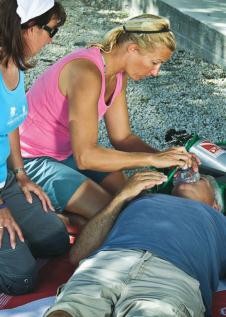
From time to time, we hear about divers administering
oxygen first aid and confusing it with chamber treatment
protocols by giving air breaks to the injured diver. Air
breaks are unnecessary and inappropriate for a diver
breathing 100 percent oxygen at near-surface pressure.
Giving air breaks while administering oxygen first aid
diminishes the oxygen pressure gradient and reduces the
oxygen window by introducing nitrogen into the diver’s
breathing gas. This slows the elimination of nitrogen from
the diver’s body.
If you participate in prolonged evacuations from a remote
location, allowing occasional air breaks is acceptable,
although these would happen naturally as the diver eats,
drinks and goes to the bathroom. It isn’t necessary to plan
these air breaks at regular intervals.
— Nicholas Bird, M.D., DAN CEO and chief medical
officer, and Eric Douglas
41-44_Medical_Line_Fall2011.indd 41
10/11/11