
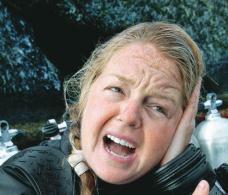
Based on the diver’s difficulty equalizing, her relatively
conservative dive profiles and her forceful equalization
attempt, some type of ear barotrauma was the most likely
explanation of her symptoms. The severity of the symptoms
seemed to indicate inner-ear barotrauma in addition to that
of the middle ear. Inner-ear barotrauma means a perforation
of either the round or oval window, the two membranes
of the inner ear. This injury is usually treated with bed rest
with the head elevated, avoidance of lifting or straining, stool
softeners (to further minimize straining) and medication
to relieve the nausea. The purpose of these therapies is
to give the perforated membrane a chance to heal, and
most individuals recover without complications or other
interventions, as this diver did.
DISCUSSION
Middle-ear barotrauma is the most common injury resulting
from diving. It is a consequence of inadequate pressure
equilibration between the middle ear and the ambient
pressure of the external environment. During descent the
Eustachian tube, which is normally closed, may fail to open
if the diver does not make effective attempts to equalize or if
congestion is present. Failure of the Eustachian tube to open
can create negative pressure within the middle ear, which
further closes the Eustachian tube and may draw fluid and
blood from the surrounding soft tissues into the middle ear
space. All of these factors can make subsequent efforts to
equalize more difficult. Symptoms of middle-ear barotrauma
include sensations of fluid or fullness in the ears, muffled
hearing, mild tinnitus, dizziness and mild to moderate vertigo.
Early in our dive training we are taught we should never
dive with congestion, a head cold or allergy symptoms, as
these can interfere with equalization. Unresolved symptoms
of middle-ear barotrauma — even mild ones — should
also be considered reasons to suspend diving. The fluid,
inflammation and closed Eustachian tubes will complicate
equalization and place divers at increased risk for more
serious injuries such as inner-ear barotrauma. Sudden
pressure changes due to rapid ascents, rapid descents or
forceful equalizations further elevate this risk.
Remember, if you encounter any equalization difficulty,
stop descending, ascend a few feet and attempt to equalize
again. If you cannot equalize, do not make a forceful attempt;
abort the dive instead. Neither middle- nor inner-ear injuries
are inherently life threatening, but nausea, vomiting and
especially vertigo while submerged can place a diver at great
risk and may even be fatal. Don’t be complacent when it
comes to equalization, and don’t ignore ear discomfort while
diving. Despite expenses paid or plans made, our hearing
and lives are much more valuable. By discontinuing diving as
soon as symptoms appear and staying out of the water until
they resolve completely, divers can avoid increasingly serious
injuries and prolonged recovery times.
AD
www.alertdiver.com
|
55
Check out the “Diver’s Complete Guide to the Ear”
on www.DAN.org.
WANT TO KNOW MORE?
54-55_Incident_Insight_Fall2011_new.indd 55
10/14/11