This is a SEO version of AlertDiver_Summer2011_web. Click here to view full version
« Previous Page Table of Contents Next Page »DIVE FITNESS
The DAN Guide to Healthier Diving
Interval Training:
The High-Efficiency Workout
T e x t b y J e s s i c a B . A d a m s , P h . D . , a n d S t e p h a n i e N . D e l T u f o , B . A . P h o t o s b y S t e p h e n F r i n k
To avoid an increased risk of decompression sickness, DAN ® recommends that divers avoid strenuous exercise for 24 hours after making a dive. Always make sure you have medical clearance to exercise during your annual physical exam or following any changes in your state of health.
NOTE
M
any exercise programs target a single fitness variable, improving only that aspect of fitness. The demands of scuba diving, however, include varying combinations of muscular strength, muscular endurance, power, cardiovascular endurance and flexibility. Interval training is effective for simultaneously improving all these fitness variables for a safer and more comfortable scuba experience.
Your muscular strength will increase as you move your body weight in a controlled manner through the exercises presented here. Muscular strength is important for lifting yourself and your gear before and after diving. The more repetitions you complete, the more your muscular endurance will improve, reducing muscles’ recovery times. Rather than taking a breather after donning your gear, you’ll be able to get right into the water. As you increase the speed of your movements and launch off the ground during the squat push, you will improve your power — the work you can do in a given period of time. Improved power is particularly beneficial in diving when climbing a ladder or entering or exiting the surf.
Maintaining an elevated heart rate throughout the workout will improve cardiovascular endurance, which is how efficiently your heart and lungs deliver oxygen to the rest of the body. Interval training has been shown to be highly effective at improving cardiovascular efficiency. As you decrease the amount of rest time between sequences (toward a goal of no rest), you will increase cardiovascular endurance. This allows your body to operate at a lower percentage of its maximal capacity, leaving a greater reserve for any challenging conditions that arise.
The exercises shown here have the added benefit of enhancing flexibility, one of the most frequently neglected components of fitness. In addition to improving your range of motion (ROM), added flexibility leads to a reduced risk of injury. In diving, flexibility comes into play while wriggling into a wetsuit, reaching for a tag line or untangling hoses.
Interval training also burns calories. Your body is constantly working hard as specific muscle groups alternate between work and rest. When one group of muscles is actively working, other groups are recovering. This is a challenging workout without any breaks, but each sequence is only 4 minutes long with a 30-second calf stretch at the end for recovery.
24 | SUMMER 2011
Exercise Directions
Focus on maintaining a full ROM and proper form while completing each exercise; quality is much more important than quantity in any workout. As you progress, increase the number of repetitions in each 30-second exercise, and try to work up to three sequences.
Sequence (30 seconds each): 1. Butt kicks (lower intensity) 2. Squat push (higher intensity) 3. High knees (lower intensity) 4. Squat push (higher intensity) 5. Frankensteins (lower intensity) 6. Push-ups (higher intensity; slow) 7. Mountain climbers (higher intensity; fast) 8. Calf stretch (recovery) 9. Repeat as you can.
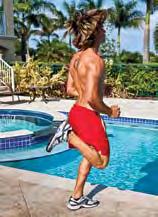
Butt Kicks (lower intensity)
Butt kicks will strengthen your hamstrings while stretching your quadriceps.
1. Butt kicks can be done in place or traveling across whatever space is available.
2. Alternate trying to bring each heel all the way to your buttocks.
3. Start at walking speed, and gradually increase speed without sacrificing ROM.
This is a SEO version of AlertDiver_Summer2011_web. Click here to view full version
« Previous Page Table of Contents Next Page »