This is a SEO version of AlertDiver_Summer2011_web. Click here to view full version
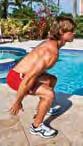
« Previous Page Table of Contents Next Page »Squat Push (higher intensity) The squat push will work your entire body, focusing on power.
1. Start with feet shoulder width apart, shoulders back and head up. 2. Swing your arms back while sitting your buttocks back.
3. When your thighs are nearly parallel to the ground, swing your arms forward and up while extending your hips, knees and ankles.
4. Do not leave the ground at first; just get up onto your tiptoes. 5. When and if your joints are comfortable, repeat, launching straight up off the ground.

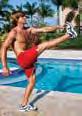
High Knees (lower intensity) High knees will strengthen your hip flexors, stretch your gluteals and
hamstrings, and improve your balance. 1. Lift your knee as high as it can go. 2. Then, and only then, hug the knee toward your chest; alternate.

Frankensteins (lower intensity) Frankensteins also strengthen your hip flexors and quadriceps, stretch your
hamstrings and gluteals, and improve balance. 1. Maintain an upright posture with chest and head up. 2. Bring your right leg up to touch your left fingertips; alternate. Tip: Try to keep your fingertips at shoulder level.
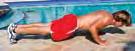
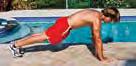
Push-Ups (higher intensity; slow) Push-ups build muscular strength in the pectoralis major, tricep and anconeus muscles. Your abdominals and lower back will build muscular endurance as they stabilize your body. 1. Start in plank position with hands under your shoulders.
2. While keeping your spine in a neutral position (no sagging back or elevated buttocks), flex your elbows until your upper arms are horizontal to the ground.
3. Don’t worry if you can’t get your arms all the way horizontal; you will get a little further with each workout.
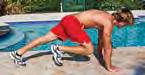
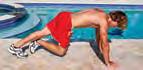
Mountain Climbers (higher intensity; fast)
Mountain climbers are designed to improve upper-body strength and endurance while increasing power and speed in the lower limbs.
1. Start in plank position with hands directly under the shoulders as with the push-up.
2. Bring your knee to your chest, placing your foot on the floor under your chest; alternate. Tip: Start slowly, making sure to bring your knee and foot as far forward as possible. Each time you complete the workout, your speed and ROM will naturally increase.
Calf Stretch (recovery)
Stretching the calves (an area prone to cramping during finning) is particularly important after completing these exercises. Calves are accustomed to walking, but the power involved in the squat push and mountain climbers can be stressful.
1. While supporting your weight on your hands in the mountain climber position, alternate pressing each heel toward the floor.
2. The leg of the calf being stretched will support most of your weight during this exercise.
ABOUT THE AUTHORS
Jessica Adams and Stephanie Del Tufo are a sibling team actively engaged in research on the body and brain, respectively. Jessica is an assistant professor in the department of physical education at Kean University in Union, N.J. She is co-author of Fit for Scuba, a strength and conditioning handbook and a proud alumna of the DAN internship program. Jessica is also a Health Fitness Specialist certified by the American College of Sports Medicine. Stephanie is a technical research assistant in the department of brain and cognitive sciences at the Massachusetts Institute of Technology. She earned her B.A. in neuroscience at Smith College. AD
www.alertdiver.com | 25
This is a SEO version of AlertDiver_Summer2011_web. Click here to view full version
« Previous Page Table of Contents Next Page »