This is a SEO version of AlertDiver_Summer2011_web. Click here to view full version
« Previous Page Table of Contents Next Page »M
ost divers are aware that definitive treatment for decompression illness (DCI) usually involves a hyperbaric chamber. There are several different types of chambers; some are appropriate for treating injured divers, and others are not. DAN’s primary mission is to facilitate access to appropriate medical and hyperbaric care. We asked our experts to discuss some of the current issues in hyperbaric medicine with the intent to enhance our membership’s understanding of chamber types, use and availability. Such insight may be of great interest to divers creating an emergency action plan, preparing for remote travel or facing treatment for DCI.
Wh a t types of chambers exist for the treatment of divers?
TomWorkman: As described by the National Fire Protection Association (NFPA), there are three primary classifications for chambers: Class A, B and C. All chambers must satisfy stringent design and manufacturing criteria established by the American Society of Mechanical Engineers (ASME) Pressure Vessels for Human Occupancy (PVHO) Technical Committee. Accredited health-care facilities provide hyperbaric medical care for clinical conditions that are approved by the Food and Drug Administration (FDA), the Undersea and Hyperbaric Medical Society (UHMS) and the Centers for Medicare and Medicaid Services (CMS). Class A, or multiplace, chambers come in various sizes, accommodate multiple patients and have attendant staff within the chamber. Multiplace chambers are pressurized with air, and patients are fitted with a clear plastic hood or face mask that delivers oxygen. With proper staff training, multiplace chambers enable the treatment of all approved hyperbaric indications, including DCI.
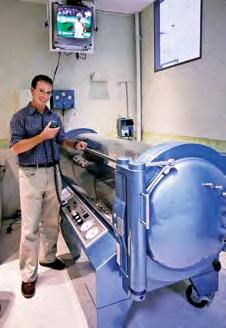
Class B, or monoplace, chambers are intended for the treatment of one patient at a time. These chambers make up the majority of chambers in the United States. Class B chambers are usually pressurized with 100 percent oxygen and with properly trained staff can also be used to treat all approved clinical indications, including DCI.
Class C chambers are for animals and are not used to treat people.
Transportable hyperbaric chambers are those that enable movement of a patient between facilities. These may be small Class B or more portable Class A chambers. A well-known manufacturer of these units is SOS Hyperlite. These single-person chambers enable emergent treatment and potential transportation of divers, but for practical reasons they are not ideal for other clinical applications or repeat treatments.
In recent years the market has seen an increase in the sale of “mild” or “soft” chambers that are commonly sold to health spas and to individuals for use in their homes. These fabric chambers are limited by the FDA to pressurization with air (rather than oxygen) and are FDA approved only for the treatment of acute mountain sickness (see “Incident Insight,” Page 48). Their use is not approved for any hyperbaric clinical indications, and they do not comply with any of the recognized safety regulations for hyperbaric chambers.
36 | SUMMER 2011
Hyperbaric Chambers for Dive Injuries
RESEARCH, EDUCATION & MEDICINE // E X P E R T O P I N I O N S
B Y N I C H O L A S B I R D
Monoplace, or class B, chambers are filled with 100 percent oxygen and accommodate a single patient.
This is a SEO version of AlertDiver_Summer2011_web. Click here to view full version
« Previous Page Table of Contents Next Page »