This is a SEO version of AlertDiver_Summer2011_web. Click here to view full version
« Previous Page Table of Contents Next Page »Is any type of chamber better than others for treating divers?
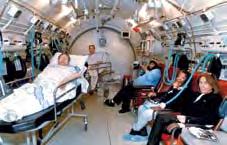
Workman : All approved Class A and B chambers that function in an appropriate health-care setting with trained staff can treat dive injuries with equal effectiveness. While large multiplace chambers may be more comfortable for prolonged treatment, they are no more effective in treating DCI or any other approved hyperbaric indication than smaller monoplace chambers.
What options for treating DCI exist in remote operational settings where access to a hospital-based chamber is significantly delayed?
Matthew Partrick: When treating DCI in remote locations,
MEET the experts
Dick Clarke, CHT, is the president of National Baromedical Services and the National Board of Diving and Hyperbaric Medical Tech-nology. He also directs the Baromedical Research Foundation, a nonprofit organization dedicated to the scientific advancement of hyperbaric medi-cine. Clarke has taught diving and hyperbaric medicine since 1976.
Matthew S. Partrick, M.D., is board certified in emergency medicine and diving and hyperbaric medicine and completed a hyper-baric medicine fellowship at the University of Pennsylvania. He is the medical director at the Institute for Diving Medicine in Ocean County, N.J.
W.T. “Tom” Workman, MS, CAsP, CHT, FAsMA, is the director of Quality Assurance and Regulatory Affairs for the Undersea and Hyperbaric Medical Society (UHMS). Workman is the principal architect of the UHMS chamber facility accreditation program and the leading expert on chamber safety.

www.alertdiver.com | 37
This is a SEO version of AlertDiver_Summer2011_web. Click here to view full version
« Previous Page Table of Contents Next Page »