This is a SEO version of AlertDiver_Summer2011_web. Click here to view full version
« Previous Page Table of Contents Next Page »Tubbataha is a seasonal destination, best accessed from March through June, when the Sulu Sea is calmer. It’s recognized as one of the Philippines’ marquee attractions for wide-angle vistas and pelagic sightings. Consider this email I recently received from Randy Wright, captain of the Atlantis Azores liveaboard, describing his week on charter:
“Just back from Tubbataha and my best week of diving in years. Multiple whale shark encounters, mantas on several dives, heaps of sharks and jacks, etc. Dozens of turtles … felt like Sipadan! Eagle rays, and on our last dive of the week we got a whale shark and then a great hammerhead about 2 minutes later! Could not have planned it better. Best week of diving in the Philippines without a doubt! Of course, I had no camera coz I was leading all the dives … just a huge folder of mental snapshots.”
I had been to Tubbataha with a group just the month prior, and we had some incredible diving, particularly with beautifully decorated walls and absolutely pristine concentrations of hard corals. However, we did not experience the high-voltage pelagic sightings Randy so enthusiastically describes. But I guess that’s how it goes in a locale situated atop the Cagayan Ridge in the heart of the Sulu Sea, 90 miles and a 10-hour steam from Puerto
Princesa. Things change day to day, depending on the critters in residence. Gratefully, even beyond the rare and wonderful megafauna, Tubbataha delivers consistent dive excellence. Tubbataha is an atoll, a volcanic seamount that gradually sank, leaving a circular substrate for coral colonization, now punctuated by a few low-profile sand islands. Home to 359 species of coral, 600 species of fish, 56 species of
invertebrates, 12 species of sharks, and abundant populations of two different turtle species, Tubbataha is a nearly 250,000-acre United Nations Educational, Scientific and Cultural Organization (UNESCO) World Heritage Site. As such, it is common property of the world, but the Filipinos have the primary responsibility of conservation and enforcement. Rangers are in residence year-round to prevent poaching and to ensure the impressive congregations of seabirds are left unmolested.

Europe. Like Anilao, there is plenty of talk about the critter diving here, but not much is heard about its underwater scenery. This seems a little odd when you consider that the most famous dive sites here are three wrecks — two small wooden vessels and a sailboat — located just off Sabang Beach . The Sabang wrecks are loaded with marine life, most notably large frogfish so perfectly posed on upper decks and railings that we couldn’t help referring to them as supermodels. Several other wrecks and some natural reefscapes are also available; nearby Verde Island’s above-water peaks give way to steep
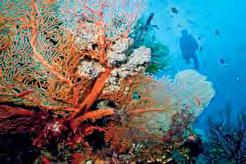
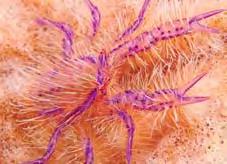
underwater dropoffs covered with large sea fans and gorgonians and inhabited by batfish, turtles and barracuda. Like Anilao, Puerto Galera’s reputation as a critter haven is well-earned. Some of the best small marine life can be found immediately offshore in Sabang Bay, minutes away frommost of the resorts. Among the sand and rubble are Napoleon and crocodile snake eels, ghostpipefish, flying gurnards, nudibranchs and frogfish. The Sabang moorings are a popular site for night dives and a common place to spot stargazers and a variety of lionfish. SinandiganWall is home to (surprise) tons of
nudibranchs, so many that our group nicknamed it “Nudi Wall.” Manila Channel is a good bet for finding pygmy or flamboyant cuttlefish and the odd-looking devil scorpionfish.
he Dive Season
It is generally agreed that the ideal time to visit the Philippines is from April — after the windy, dry season ends — through June, before typhoon season starts. Popular destinations such as Anilao, Puerto Galera and Dumaguete are busy year-round. Water temperatures range from the mid-70s in winter to the low-80s in summer.
From the Visayan Sea in the central Philippines to the Verde Island Passage up north, this island nation treated us to a fascinating variety of underwater experiences and images. At the end of our visit, the ride back to the Manila airport was occupied by a playful argument about whether the tiny critters were most impressive or whether the reefscapes, massive schools and marine vistas took the cake. Eventually we reached an impasse, which brought us to this point — do not be fooled into thinking that size matters when it comes to the underwater world of the Philippines. AD
B y S t e p h e n F r i n k
Tubbataha Reefs Natural Park
72 | SUMMER 2011
T
This is a SEO version of AlertDiver_Summer2011_web. Click here to view full version
« Previous Page Table of Contents Next Page »