This is a SEO version of AlertDiver_Summer2011_web. Click here to view full version
« Previous Page Table of Contents Next Page »ofshore rom the blufs that lift ncient Maya toward the nly when ettled into eat on the to Mexico did I begin leafng through the guidebook I had tucked into my backpack. Let’s see, what to do? About 40 minutes later I had my answer: Dive the cenotes. Shortly after arrival, my family departed the lovely yet simple Ana y José hotel and set of along Boca Paila Road to fnd the MexiDivers kiosk in Tulum’s retail zone. By the time we passed the casual tourism police checkpoint at the end of the row of eco resorts, yoga retreats and open-air restaurants, I was eager to talk diving. At the kiosk, having verifed our dive credentials, Nicolas described our options — exploring cenotes or diving ofshore reefs. We chose both.
Our adventure began among shaggy roots of mangrove trees bordering the turquoise-green water of Cenote Manatee, an open-air lagoon. We wove our
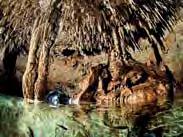

way through craggy ravines fooded with a confuence of fresh- and saltwater currents that created vision-obstructing haloclines. We hovered over a tangle of crabs feasting upon the shrunken remains of a turtle tucked beneath a rocky outcropping, then we foated with the lazy current, back the way we came. In Cenote Dos Ojos we slithered among limestone columns in the darkness, led only by the dim glow of our fashlights and the golden guideline strung through the caves to prevent us from straying into the eerily beckoning peripheral caverns. We surfaced in dark caves flled with crystalline water only to be assaulted by the screeching of hundreds of bats darting and diving in the dim recesses above us. Quickly submerging, I thought it funny how swiftly
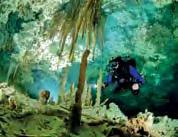
perceptions can change — the usually alien underwater world was a welcoming and hospitable place in the face of a hoard of beating, leathery wings. Winding through the many tunnels and chambers of Gran Cenote, we carefully maneuvered around delicate stalactites and stalagmites to avoid erasing decades of geological development with a single misplaced fn kick. We threaded our way among the submerged pilings of an old wooden structure. At one time it was scafolding to provide access to the cave via the natural oculus in the domed ceiling; now the collapsed ladder stretched in vain toward the shaft of sunlight and roots dangling just beyond its reach. Hmm, who built you? With no time to pause, we moved on, skimming along the cave foor amid
hundreds of tiny fsh. We emerged at last into the sparkling waters of a huge cavern, cracked wide open to the lushness of the sunny green jungle above. As we carefully ascended the slimy, wobbly steps of the ladder to our exit, I looked around to see the same awed and jubilant expression on the others’ faces. In that moment we felt lucky — lucky that out of the devastation of a cataclysmic event, were given the gift of the cenotes. Lucky to have found Tulum. Lucky to be divers. AD
www.alertdiver.com | 81

T
he cenotes of the Yucatan were the lifeblood of the Maya Empire. Unlike many other ancient civilizations, which formed around the Ganges, the Euphrates or the Yangtze rivers, the fresh water on which the Maya depended was mostly beneath the surface. Today there is a dedicated cave-diving community that is immersed in exploration of the Yucatan’s underwater caves. During the 1997 Nohoch Nah Chich project, Mike Madden and his Cedam cave-diving team found that 36 cenotes were connected by more than 42 miles of underwater caves that plunged to depths of more than 230 feet. Photographer Kurt Amsler visited on assignment in 2008 to document the presentation of a Rolex Award for Enterprise to Arturo Gonzalez, a Mexican biologist and underwater archaeologist. The Gonzalez team discovered human remains estimated to be 11,600 years old and ancient fireplaces 100 feet below the surface, certain evidence of dramatically different sea levels, perhaps 300 feet lower than today. (See “Parting Shot,” Page 104.) Beyond the obvious recreational attraction of the cenotes, they provide a wealth of information about the history of the region. According to Gonzalez, “As an inhabitant of the Americas, I’m interested in knowing who these people were, where they came from and when their first steps in the Americas occurred. In these sites we can find the archaeological contexts just about as they were left by the people of the Ice Age. It’s a great treasure.”
w a t e r s

F
rom ruins and reefs to white sand and green energy, Tulum has much to offer offshore and above ground, as well as below. See www.AlertDiver.com for more on this jewel of the Riviera Maya.
O N L I N E
This is a SEO version of AlertDiver_Summer2011_web. Click here to view full version
« Previous Page Table of Contents Next Page »